Tuesday, October 16, 2018

Preferred by Discreet Women Everywhere makes the most of its unique setting

Photo by Scott Pakudaitis

Freshwater Theatre’s Ruth Virkus takes us to a place that half of the potential audience has almost no knowledge of, while the other half know it intimately: the public women’s bathroom.

Preferred by Discreet Women Everywhere joins together three discreet short plays into a single evening, all set within the confines of a restroom at a somewhat swank Minneapolis joint – to explore the relationships women have among each other. The men in their lives are only spoken of, never seen. (It’s safe to say that these plays pass the Bechdel Test.)

The title play centers on a rather sudsy plot, as two old high-school friends meet for the first time in years. Mary, a local TV celebrity, is hiding not just from a blind date, but also from a man she had a quick affair with just weeks previously. The man, it turns out, is her old friend’s, Lauren’s, husband.
While some of the plot turns on the usual delight of trying to hide a terrible secret no matter what, the real meat of the play comes from the interplay between Mary and Lauren and where their lives have gone since school. Beyond the superficial success – Mary’s career, Lauren’s family – lies a bevy of anxiety centered on whether or not the choices they have made are the right ones.

In the brief “Lucy and the Calamity of Jane,” the two characters are soon to be step-mother and step-daughter. Lucy, the teenage step-daughter, is afraid that the marriage will ruin the relationship she has forged with Jane, and that her father’s string of failed marriages will claim Jane as well. Jane, for her part, works to convince Lucy that the changes will be for the better, even as she is aware of the pitfalls that lie ahead.

Finally, “10:00, Bistro Caprice” finds middle-aged Lydia in a pickle. She arrives in a panic, with red wine staining her $400 silk blouse. In moments, she has doused the whole thing in water, but then realizes she has stripped to her bra, and has nothing to cover it to make her escape out of the restaurant.

What follows, and what makes this the most affecting of trio of plays, is Lydia coming to grips with issues of middle-aged sexuality, body image, and being able to define herself outside of a relationship (we have another divorcee here). The script, along with Mame Pelletier’s performance, moves Lydia through quite a journey in a short amount of time, leading to her final, triumphant and even moving walk out of the bathroom.

The performances are solid throughout and give a lot of life to Virkus’ already meaty scripts, as does the strong directing work of Nicole Wilder. It's a sometimes wild, sometimes funny, and often insightful ride.

For tickets, visit online. The play runs through Oct. 28

Monday, July 16, 2018

Kevin Kling and Victor Zupanc fight the summertime blues at CTC

Photo by Dan Norman
Kevin Kling is a Twin-Cities treasure. His quick humor, off-kilter perspective, and deep storytelling gifts make any of performances can't miss.

For many years, he's offered up a summer show. Often at the Minnesota Fringe Festival, or (in more recent years) at Open Eye Figure Theatre. This year, its moved over to the Children's Theatre Company. While it may be geared for a slightly younger set, "The Best Summer Ever" is full of seasonal delights about every kid's favorite time of the year.

Music has often been a key component of the shows. This time out, Kling conspires with Victor Zupanc. CTC's longtime musical director makes an engaging companion for Kling, offering up just the right backdrop for, say, an adventure involving a car wash, a stolen car, and an ice cream truck, or just leading the crowd in a traditional Norwegian folk song.

Kling takes on the role of Maurice Anderson, a young Minnesotan with a big imagination. He's got an older brother who is a constant terror and an older sister who he doesn't quite understand. The summer doesn't get off to the best of starts, as Maurice and his family have to travel north for his great-uncle's funeral. There, he fibs to his grandfather about his farming skills and ends up with some of the last seeds from the old country (and a spare chicken to boot).

From there, it's a wild ride through the seemingly endless days and nights of the summer. Maurice likes to live inside his head, and does things like create nature shows out of his head. Against this backdrop, there's his lonely grandpa, who keeps visiting to have tests done at the hospital, and his not-so-successful garden.

This tapestry allows for some wild tales, like his brother's trip to Norwegian Camp. That ends, naturally, with an attempted invasion of the other camps around the lake, which gets scuttled when the band camp kids turn out to be much tougher than they look.

Along with the hijinks, there is a lot of heart, which is par for the course in one of Kling's shows. You'd have to be particularly hard-hearted to not feel pangs (or even shed a few tears) at the show's expansive conclusion. A lot of that is down to Kling's storytelling and Zupanc's music, but Liz Howls' animations really help to make the finale hit home.

For more information, visit online.

Wednesday, June 13, 2018

Equivocation is a powder keg of a show from Walking Shadow

Photo by Dan Norman
What if the greatest playwright of the age had been approached by the government to write a propaganda piece about a recent, attempted terrorist attack only to discover that the “truth” behind it was much thornier than the smooth surface.

That’s the plot of Bill Cain’s “Equivocation,” which takes this John Grisham-like plot and drops in the middle of early 17th-century London, where William Shakespeare finds himself with the impossible task of writing a play about the Gunpowder Plot.

This is perfect territory for Walking Shadow Theatre Company, whose past work includes Shakespeare-adjacent works like A Midwinter Night’s Revel and “Shakespeare’s Land of the Dead.” Though Cain’s script occasionally wanders, the tight direction and fascinating story carry through this compelling evening of theater.

One day, Shakespeare is called away from the Globe – where the company is hard at work making sense of “King Lear” – to meet with Robert Cecil, the behind-the-scenes controller of the King, court, and country. He – King James or Cecil, there’s not much difference – wants Shakespeare to write the “true” story of the recently attempted Gunpowder Plot, where a group of young, radical Catholics attempted to blow up Parliament and start a revolution.

From the get go, there is pressure everywhere: from Cecil, from the other actors in the company, and from Shakespeare (called Shagspeare or Shag here) himself, who realizes that a play about a plot that doesn’t succeed isn’t particularly good drama.

This pushes Shag to hunt deeper for the truth, and after a few interviews with the surviving conspirators and his own keen knowledge of human behavior, he finds an alarming plot behind the plot. There’s a real story here, but it means telling the truth. Mind you, this is an era where the wrong word can get you hung, drawn, quartered and your head hung on a pike.

Cain uses this to look the difficulty of uncovering and telling the truth in difficult times, whether it’s Jacobian England or our modern day, where any uncomplementary story is labeled as “fake news.” Beyond that, there are issues of art, collaboration, loyalty, and family – the last is a big one, as Shag has a troubled relationship with his daughter, Judith.

In other words, Cain put a lot on his plate. It makes for a sometimes overstuffed show, as ideas are constantly tossed around. Yet, while this may eventually make for an exhausting last 20 minutes (which includes whole swaths of one of Shakespeare’s plays), the overall effect is ultimately engaging.

Give director (and Walking Shadow co-artistic director) Amy Rummenie plenty of credit, as she molds all of this material into a sharp thriller that holds all of the stray ideas together. The company is also well chosen, though Walking Shadow’s co-artistic director John Heimbuch had to step into the key role of Richard, Shakespeare’s confidant and friend, at the last moment. During Saturday’s performance, he was still on book and working to meld fully with the rest of the company.

The other performers are all strong, especially Damon Mentzer as Shag and Eva Gemlo as Judith. Once Heimbuch has a chance to settle into the role, they whole company should be able to fire on all cylinders.

Equivocation runs through June 24 at the Gremlin Theater in St. Paul. Visit here for more information.

Sunday, February 25, 2018

Constance in the Darkness is great art from Open Eye Figure Theatre

Photo by Evan Frost
There are a number of truths about the Twin Cities theater community, and one of those is that no matter what Open Eye Figure Theatre puts together, it will be -- at the very least -- intriguing.

The company's mixture of high-class puppetry, top-notch performances, and deep-probes of the human psyche come together in the enthralling and brilliant Constance in the Darkness.

Constance (Emily Zimmer) is off exploring when she gets a series of frantic calls from her mother. Mom is lost and needs her daughter to help her get home. This leads Constance into an ever spiraling series of adventures that take her deep into her childhood. There, she finds an ally in Bobo, her beloved-but-certainly-broken-down beloved bear, and fights against the terrors of some of her less savory toys: Queen Harmonica and Lamby Lamb.

There's also a fairy godmother and a narrator tying all of this together. Most of the roles apart from Constance are played by Maren Ward, who once again does terrific work on the Open Eye stage. Ward moves from role to role like a whirlwind, driving the story always forward. (And don't expect any handholding here; you are going to have remained fully engaged with the twists and turns of the story to get the most out of Constance and her adventures.)

Created by Open Eye's Michael Sommers and Joseph Evans, <i>Constance in the Darkness</i> is an inventive ride that just makes you giddy to be alive and experiencing such great art.

For information, visit here.


Wednesday, February 7, 2018

Blows against the Empre: The Royale

Photo by Justin Cox
Though set in the early years of the 20th century, Marco Ramirez’s The Royale is remarkably prescient about race and sports in America.

A lot of that has to do with our country’s stubborn, almost pathological, inability to deal with its troubled past. It’s much easier to paste over the issues with platitudes and Ram truck commercials than to actually come face to face with the collected racism of white America.

In The Royale, making its regional premiere at the Yellow Tree Theatre, Jay Jackson is a barnstorming boxing champion defeating all challengers – as long as they are black. He dreams of coming face to face with the white champion.

When that opportunity comes, it becomes more than just two men trading punches in the ring. Against a backdrop Jim Crow America, Jackson sets off a firestorm of tension. Will reaching his dream cause others to suffer?

There’s more to unpack in this topic than a year of plays, documentaries, and discussions can uncover. Ramirez instead paints with an impressionist’s brush. Clocking in at around 75 minutes, we get touches of the tension beneath the surface from the way Jackson interacts with others, from his sparring partner to his long-time coach to his manager.

Director Austene Van makes the most of these tools. The boxing becomes a ritual dance of bobbing, weaving, and punches. By the end, each virtual punch (there is no actual pugilism on stage, apart from some light sparring) packs a wallop far beyond the ring.

Several terrific performances help to bring this to life. David Murray has the look and swagger of a champion as Jackson. There is a singular determination to Jackson’s quest, and Murray plays it perfectly. As the tension increases, so does the worry in Murray’s face, but Jackson’s underlying confidence never wavers.

James Craven and Charles Fraser play a pair of mentors. Craven is electric as always as Wynton, who has guided Jackson through the rough roads of boxing. Fraser gets a thornier character, as promoter Max has Jackson’s best interest in mind. Is it genuine, or is just because Max needs Jackson to keep making money? That tension is written throughout Fraser’s performance.

By the end, The Royale leaves you exhausted and exhilarated. After all, the weight of American racism – and how it relates to sports – is felt heavily today. (Hello, President Trump!) Yet the power of Ramirez’s writing, Van’s direction, and the company’s acting make it a rewarding trip to the theater.

For more information, visit online.

The road isn't all that easy in The Wiz

Photo by Dan Norman
The Wiz is not a great piece of musical theater. Apart from the music, its soulful twist on The Wizard of Oz hasn’t aged all that well. The book is blah and the story misses plenty of important beats from the original that make it feel more like discreet episodes instead of a fully unified story.

The combined talents of Penumbra Theatre and the Children’s Theatre Company do their darndest to make it work. While the final product is far from perfect, it is much more entertaining than the various parts would indicate.

Dorothy is still from Kansas and is still under the care of her Auntie Em and Uncle Henry. The difference? The family is African American, and when the twister comes and takes her to Oz that fantastical land is modeled after New York City.

After landing on Coney Island, Dorothy makes her way south, picking up her familiar friends (though Toto is seen at the beginning and end, he is missing in action for most of the show) on their journey to see the Wizard. In this case, the Emerald City is the Apollo.

And yeah, you know the story from here. Wizard scares the quartet into taking care of the evil witch, Evillene. They dispatch her without much trouble, come back, get their rewards, and learn valuable lessons about themselves.

Mind you, this 1970s-era musical wasn’t trying to create a new interpretation, like Wicked. The Wiz really just wants to tell a familiar story with some punched up, soulful tunes. Songwriter Charlie Smalls gives the company plenty of great moments to dig into, from the funky choruses of “Ease on Down the Road” to a string of solos that threatened to bring the house down.

We’ve got Greta Oglesby, cast as Aunt Em and Evillene, reaching for the rafters on two numbers, the opening “The Feeling We Once Had” and “Don’t Nobody Bring Me Bad News.” Paris Bennett sings well throughout as Dorothy, and it is hard to go wrong with the likes of Dennis W. Spears, Aimee Bryant and T. Mychael Rambo filling out the cast.

When they are singing, The Wiz is great fun. It’s harder for the company to overcome William F. Brown’s sludgy script. All of the hard work done by the company, the creative team, and director Lou Bellamy can’t save us from the fact that we’re watching a facsimile of the original story, and like so many copies, it doesn’t capture all of the details of the original.

Visit online for more information.

Thursday, January 18, 2018

Ishmael: The greatest fishing tale of them all

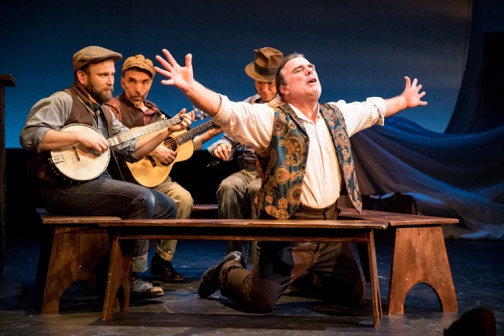
Nate Sipe, Jim Parker, Kevin Kniebel (musicians); Jack Weston
(Photo by Dan Norman)
Sometimes dragging yourself out of the house during the Minnesota winter seems like a terrible burden. It’s warm at home. There’s no terrible road conditions, low visibility, lower temperatures, or awful parking to deal with when you choose not to go out.

Still, there are rewards for the brave, such as the Jungle Theater’s new production, Ishmael.As you might guess from the title, this is a version of Moby-Dick. It’s been trimmed down to a slim 90 minutes, but does so by honing in on the core of the tale: the madness of Captain Ahab, the wanderlust of Ishmael, and the scary life that awaits anyone foolish enough to sail the seas.

All of this is told through the capable hands of Jack Weston, who presents us with a campfire tale to end all campfire tales. Adapter Leo Geter uses only words from Melville’s original novel. That means it retains the original tone even if the events have been scaled back.

The story does take its time getting started, but the lengthy prologue helps to set Ishmael’s character and allows the audience to sink deeper and deeper into the story, until we – like our narrator – are almost drowning under Ahab’s mad passion.

Weston isn’t alone on stage. A trio of musicians – two drawn from neo-bluegrass outfit Pert Near Sandstone – offer support, as they sing traditional tunes or provide the occasional “crowd” when needed. The focus, however, remains on Weston, whose dazzling performance makes it feel like we are right there on the Peqoud with the doomed crew.

Find out more here.


Addendum (or a scary look into the way my mind works)

Moby-Dick has made an impact on lots of culture, including rock and pop music. Led Zeppelin called its extended drum solo/chance for the rest of the band to score some drugs, “Moby Dick.” The doom-laden metal band Ahab took cues from the story, as did the heavier-than-thou Mastodon on “Leviathan.”

Then there’s Moby, who apparently is a distant relation of Melville, and took his name from the famous white whale. However, there is nothing heavy or mysterious about Moby or his music.