Wednesday, March 8, 2023

Walking Shadow invites you to a thrilling "Feast"


No local theater company has cut a swath quite like Walking Shadow. They have produced award-winning productions, clever Fringe shows, and a number of experienced-based entertainments. Cabal, the company’s magic-based escape room, is still going strong, while the Pandemic brought REBOOT, a Zoom-based show where I got to interview a nascent, self-aware artificial intelligence

Feast, their latest show now running at the Black Forest Inn, merges the company’s different aspects. At it’s core, it is a one-woman show about grief, revenge, and humanity. It also offers a pre-Feast feast at the Black Forest Inn. Most importantly, it is absolutely brilliant.

Megan Gogerty’s play riffs on Beowulf, turning the action away from the titular hero and onto one of the “villains” of the piece, Grendel’s mother. (If you need a quick Beowulf recap: Grendel attacks some noisy Norsemen. Beowulf come in, takes down the monster, and then defeats the monster’s mother in an epic battle beneath a lake. Typical hero stuff.)

She has resurrected herself – made a new body of clay – and has gathered the descendants of those present that terrible day to tell her side of the story. This includes recasting her son as a man not about angry violence but one interested in stubbornly defending what he thought was right, to recounting her abhorrence when she saw her son’s arm, hanging as a trophy on the wall.

Beowulf is fertile ground for a feminist recounting, as the epic reduces its female antagonist to little more than a nameless mother of a monster. Gogerty digs deep not only into the love a mother has for a son, but the natural anger against those who hurt him.

Isabel Nelson uses this framework for a terrific performance. From the moment she staggers onto the stage until the character’s eventual epiphany, Nelson commands every inch of the playing area. The script is at turns funny, tragic, and frightening, and the performer captures every nuance of that in her performance.

It’s aided by Allison Vincent’s tight direction, that keeps the show on track, even if Gogerthy’s script loses focus for a time near the end. The minimal staging – a table and a handful of props – further intensify the performance and the story.

While this certainly isn’t traditional “dinner theater,” the pre-show meal certainly adds to the experience, as it plays not only into the concept of the play, but replicates the experience where stories like Beowulf were often shared. (There are also show-only seats at each performance, and while those patrons don’t get a meal, they do get a mid-show cookie.) 

With a small venue and limited run, tickets are extremely limited.
Feast
has been extended to April 1. In addition, Walking Shadow’s John Heimbuch will present a one-man Beowulf on March 18, 25, and April 1 prior to the meal. Tickets and more information can be found at Walking Shadow’s website.

Tuesday, July 7, 2020

Learning to love musicals

A good friend and fellow lover of theater (I'm pretty sure we were in a play together all the way back in 7th grade) posted an article on Facebook about Hamilton and noted that the author's negative slant made him, at last, interested to see the show, as he has long hated musicals.

The thing is: I know where he is coming from.

For the longest time, I felt the same way. Why is the action stopping every few minutes for them to sing? People don't do that in real life, do they?

As a theatergoer, this didn't really make much of a difference to me. You can have your well-scrubbed singers; I'll be over here in this grimy found space watching some “real” drama.

Once I started actually writing about theater as my job, I knew that attitude wasn't going to make it. I had to meet my prejudices head on.

For me – and likely a lot of others who didn't “get” musicals – the breaking into song that broke the flow of the show. I wanted realism, damn it!

How did I change, then? Well, a lot of it was just careful study over decades of experience watching musical theater. That isn't the a quick-and-easy solution demanded by modern society, so here's another way to try. Do you like movies and television? Have you enjoyed the various Star Wars, Marvel comics, heck, courtroom dramas, political thrillers, or John Wick?

Those aren't realistic either. No one has laser swords in our world. Being exposed to radiation gives you cancer, not give you big muscles and turn your skin green. And the courts, boardrooms, and the mean streets of any city (that inevitably looks like Toronto) aren't at all like you see on TV. Yet we buy into them because we agreed to a contract with the art: If they are able to immerse us in their “reality,” we'll stay with them until the end.

Musical theater, then, is just another kind of reality for us to enter. There are plenty of rules to be followed and and twisted and broken, but they are there. And honestly, if you just accept the baseline reality – a world where people break into song when it is demanded – half the battle is won.

Of course, it's not just a matter of turning a switch on in your brain. There are easier places to start than others. Three hours of A Little Night Music or Les Miz may not be the best way to start. Also, I can't point to any running productions at present as putting dozens of performers in front of a full house of often august theatergoers isn't wise.

Still, there are easier places to start. Apart from having a phenomenal cast, excellent direction, and Kander and Ebb's cracking great songs, the filmed version of Chicago presents all of the musical numbers as fantasies in the mind of the murderess Roxie. The “real” world and Roxie's world are clearly delineated so you can be content to know that “Cell Block Tango” isn't really taking place in the jail. (Also, “Cell Block Tango” is seven of the most brilliant musical minutes captured on film.)

Keeping with Kander and Ebb, there's Cabaret. Except for one harrowing number in a mid-'30s German beer garden, all of the musical numbers are confined to the Kit Kat Klub, where they comment on the action of the drama, or offer texture to life in pre-Hitler Germany. (Also, you get “Mein Herr,” another few absolutely brilliant musical minutes.)

There are other examples, though maybe not as tailor made as these. The Hedwig and the Angry Inch film has its moments, but the effort to expand the story's world robs it much of the stage version's power. There, the show is presented almost entirely as a concert by Hedwig (one song is from the view of collaborator-turned-rival Tommy Gnosis, though still presented as a performance on stage).

If you dig into this, there are plenty of ways into the genre. Even Hamilton – which is rapped and sung throughout – is an easier jump than you might think. The show never makes any pretense of being a “realistic” portrayal of Alexander Hamilton's life or the founding decades of the United States. Then again, that's what theater is – people playing at reality to uncover the truth, even if that's told through an 11 o'clcock number.

Tuesday, March 10, 2020

Interstate explores queer life with pop score, plenty of heart

Photo by Rich Ryan

Interstate is a joyful, messy ride with a trio of characters trying to find their place. It’s at turns funny, tragic, heartfelt, and at times a bit unsure of its footing. Just like growing up, or being in a band. Or coming out.

Created by Melissa Li and Kit Yan, the world premiere musical now running at Mixed Blood Theatre takes us back to the now halcyon days of 2008, where an Asian queer band from New York City vans it across the country in search of their diffuse online audience.

Adrian is a singer who leaves, promising her girlfriend to stay in touch and her mother that she’ll get her law school application in on time. Dash is a poet who has become an online hero to other transgender folks looking for a community. He isn’t just out to see the country – he wants to stitch a community together.

As they cross the heartland, we see the impact the tour has on Adrian and Dash’s relationship, and the one they are having on their listeners. We see this primarily through Henry, a teenager transitioning to become a man; a difficult prospect in his small minded small town.

Li and Yan based the musical on their own tour from 12 years ago as Good Asian Drivers. There are a lot of touring stories here -- Interstate is a shared bill with a puppet show short of being full Spinal Tap – but they are often shown through the lens of gender and sexual identity.

That comes through especially in Kai Alexander Judd’s performance as Dash. The character is learning how to be a “man” on the fly, and has absorbed some less-than-savory lessons, which comes to a head in a South Dakota bar where he first, kisses his musical companion without permission, and then “man ups” against a couple of yokels.

The behavior shocks the pair, and it causes the kind of break-up drama you expect in a band story. Adrian, you see, has label suitors who want her as a solo act. The twists are somewhat predictable, but the end result is not. 

Much of that is down Henry, whose transition – which takes him from Kentucky to the queer Mecca of San Francisco – gives the story its real heart. Much of that credit can be laid at the feet of Sushma Saha, whose touching, nuanced performance gives all of the diffuse parts of Interstate greater focus.

Even when the show takes detours into internet trolls, bad reviews, and harsh audiences, it doesn’t lose its cross-country heart. The music is largely composed of everyday modern pop hooks that will fade from the memory by the time you get home from the theater, the lyrics – and the overall story – stay with long after the final bows.


Interstate runs through March 29 at Mixed Blood Theatre.

Tuesday, February 25, 2020

Frank triumphs again with The Convert


Photo by Tony Nelson
It’s been a decade since Frank Theatre tackled the work of Danai Gurira, but the wait for The Convert was more than worth it.

Frank’s 2010 production of Eclipsed was -- certainly in the mind of this reviewer – one of the best shows of that year. The Convert promises to be same for 2020. It’s a smart, heartfelt, and searing look at the toll colonialism has on the people where “civilization” has come.

The play finds us in Rhodesia at the end of the 19th century, and in the comfortable home of Chilford, an African who has converted to Roman Catholicism. He struggles with money and his mission – to convert the souls of the villagers around him to the true faith.

Into this world comes Jekesai, a young woman hoping to escape an ugly, forced marriage to a man who already has more than half a dozen wives. Chilford takes her into his home, and discovers that she is a quick study, especially in matters of faith. Jekesai – renamed Ester – converts and engages in the same crusade of Chilford.

All around them, however, is unrest. The British have turned the landscape into mines and pushed the local men to work in them. Taxes have begun to crush the locals, who need to pay just to have a place to live on lands they may have occupied for centuries.

That boiling anger turns to the locals who have “sided” with the British, Chilford and Ester; and their Westernized companions Chancellor and Prudence. That anger eventually explodes, which brings the fragile lives these characters have built crashing down around their heads.

Photo by Tony Nelson
Like any play directed by Frank’s Wendy Knox, these are not simple characters and any messages you try to take away from it are fraught with contradictions and troubles. The key for The Convert is one thing that is missing: white faces. While there are no British portrayed on stage, you can feel their weight over all of the proceedings.

Gurira doesn’t paint the traditional African tribes as any kind of paradise (see the forced marriage above) but it is clear that what has replaced it isn’t any better, even if it did bring concrete floors, nice furniture, and cricket.

All of this is brought home by the terrific performances seen from top to bottom in the show. All of the characters are equally well rounded, even Warren C. Bowles’ Uncle – who seems to be just an ogre intent on ruining young Jekesai’s life at the beginning – shows more depth in his later scenes, while the seemingly civilized Chancellor (AJ Friday) shows a darkness that was always there, just beneath the surface. Other performances are equally fluid and rounded, especially that of Hope Cervantes (part of the Eclipsed cast from 2010) as Prudence.


Leads Yinka Ayinde (Chilford) and Ashe Jaafaru (Ester) are the heart of soul of the show. Ayinde shows us the confusion and doubt that lies just beneath the surface of his character, giving this devout man so much soul.

It is clear that Jekesai/Ester is the smartest character in the play, and Jaafaru plays that to the hilt. Her eyes are always soaking up the scene around her, and she makes it clear that her mind is always a few steps ahead of everyone else. All of this gives her final haunting speech all the more weight, as if we are listening in on a tale that has been spoken around fire pits and fireplaces since the beginning of time.

The Convert runs through March 15 at Gremlin Theater.

Wednesday, February 5, 2020

Satire runs deep in The Ugly One

Photo by Dan Norman.

We all know the bromides about beauty (“beauty is in the eye of the beholder”; “beauty is only skin deep”). We’re told that those who pursue beauty are vapid, vacuous, or vane. Yet we flock to every new technique to tighten our stomachs, erase crow’s feet; or just consume endless programs about those who take self-improvement to the extreme (perhaps hoping to catch sight of a plastic surgery disaster or two).

In other words, Marius von Mayenburg is mining a deep vein in The Ugly One. And that produces theatrical riches in Walking Shadow Theatre Company’s deft production at Open Eye Figure Theatre and director Amy Rummenie.

The story of a “hideously ugly” man whose life is transformed – first for good, and then for something else – by being given a new face fits perfectly with Walking Shadow’s previous work, as the company has long explored ideas around identity and image.

Our “ugly one” is Lette, a research electrical engineer who has created a new… thing that will make things run better than before. He is all ready to deliver the news of the product at a trade conference when his boss and associate spring the news on him: His hideous appearance in no way can be connected with the new creation.

Disorientated and depressed, Lette looks into plastic surgery. More than a few nicks, tucks, and cuts later, he has a brand new face: One so beautiful it could sell the new electric doohickey to an Amish farming family.

At first things are great. Lette’s standing with his job and his wife go through the roof. He even attracts the attention of consumer electronics groupies (including a rich woman and her snide son who are engaged in activities that would make Aleister Crowley blush) on his journeys to different trade shows.

The good times come to an end when Lette notices his face on another man. And then another. And another. Soon, his beautiful face has become common, and – as last week’s news – Lette finds his status tumbling down once again.

While the play is loaded with rich satire, it’s the quality of the characters – and the performances – that makes The Ugly One more than a lost episode ofBlack Mirror.  Sean Dillon leads the way as poor Lette, who is not the most likeable of characters. Still, Dillon makes us feel the character’s pain, temporary joy, and final despair in a way that is nearly heartbreaking.

The rest of the cast (including nice turns from Edwin Strout and Julie Ann Nevill) doubles up for the various characters, with Corey DiNardo particularly good as Lette’s conniving assistant and the rich woman’s son who is able to see the world for what it is.

The Ugly One runs through Feb. 16 at Open Eye Figure Theatre in Minneapolis.

Thursday, December 12, 2019

Dog Act: The apocalypse will not be televised, but we will sell tickets to it

Ariel Leaf and Joe Wiener (Photo by Kari Elizabeth Godfrey).


The end of the world is on everyone’s minds. Sure, it has been hanging out in the back of conscious thought for as long as humans first gained sentience and thought, “Hmm, this is nice. But it won’t last,” but the intensity of our end-of-the-world dreams has only gotten stronger.

Environmental disaster. Economic collapse. The still-lingering threat of nuclear destruction. It seems like we are a thin veneer of civilization away from becoming unwilling “Road Warrior” reenactors, fighting each other tooth and nail for the limited remaining resources.

Liz Duffy Adams’ Dog Act moves the apocalypse deep into the past. Now, the few survivors don’t even have gasoline to fight over. It’s just the remaining scattered trash of our society to pick over, and mutant rodents for dinner.

While the world is dark, that doesn’t mean there isn’t room for entertainment, humor, and heartfelt emotions. The same can be said of Adams’ play, and the current production from Fortune’s Fool Theatre at the Gremlin.

In it, hope comes not from some guy who founds some letters that needed to be delivered, but from traveling vaudevillians. These company wander up and down the landscape, providing entertainment for the scattered survivors, immune from some of the degradations around them by a code that protects performers from the scavengers and cannibals that dot the land.

Even with that, our company is in dire straits. They are down to two: Zetta, the proprietor and main performer; and her loyal Dog, a man who has abandoned most of the ways of humanity to be Zetta’s loyal friend.

Their goal is to get to the coast, which – somehow – will get them to China, a long fantasied-about land where the company has a standing invitation for a command performance. In their way are two pairs of folk: Mysterious fellow travelers Vera Similitude and Jo-Jo the Bald Faced Liar; and cannibal scavengers Coke and Bud.

Vera and Jo-Jo join up for Zetta and Dog, and Vera tells of a nearby community where learning is still valued. As they trudge their way there, they are pursued by Coke and Bud, who want the youthful Jo-Jo for an important ceremony, and an even more important post-ceremony meal. As quickly as you can say “Red Kangs are best,” they are all ensnared in the adventure.
The twists of the plot are fairly easy to see, but it’s the quality of the characters and performances that gives Dog Act its heft. Ariel Leaf and Joe Wiener are convincing as our main double act. Leaf brings both grit and naïve charm to Zetta, who faces each new setback with a bright determination to find a way to a better life. Wiener matches this as the loyal Dog, who isn’t as sure about what is to come, but will stay loyal to his companion to the end.

The balance of the cast also does solid work, with Nissa Nordland Morgan’s Jo-Jo – and her shouted, emotionless storytelling that manages to be funny and scary – a particular highlight.

Director Ben Layne keeps a firm hand on the proceedings, and Ursula K. Bowden and Corrina Knepper Troth do an exemplary job with the set and props. This is dominated by Zetta’s travelling wagon, which dominates the proceedings like an end-of-the-world Mother Courage.

Dog Act runs through Nov. 22 at Gremlin Theatre.

Thursday, September 19, 2019

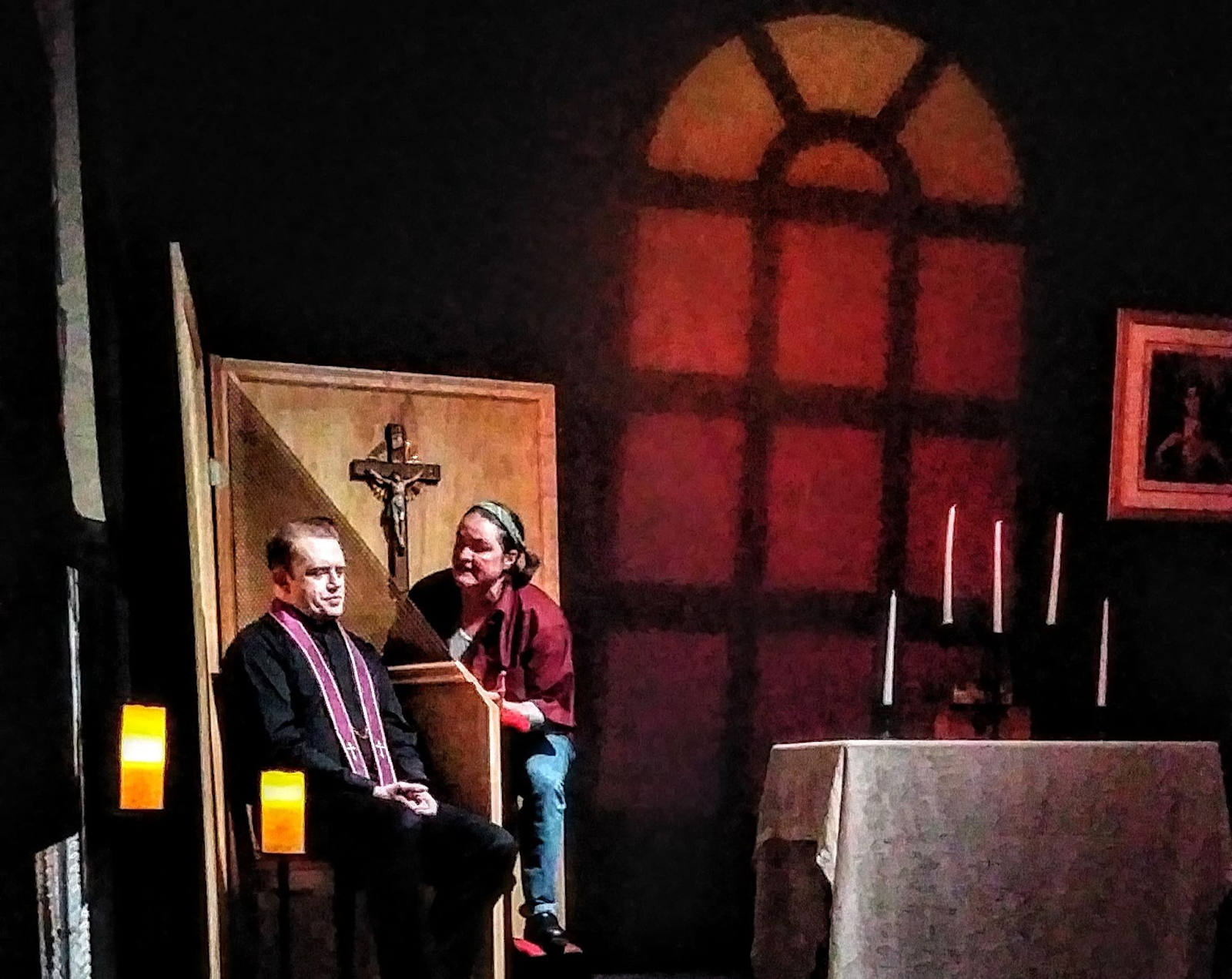
Freshwater Theatre's Immaculate Heart offers insight into negotiating Catholicism and sexuality

Image courtesy Freshwater Theatre
No matter how long its been since you have been to mass, called a parish home, or gone to confession, you never shake being a Roman Catholic.

I haven't been a church goer since 1987, but at a funeral last week, I felt myself going through the old motions, finding comfort in the familiar rhythm of the mass, even feeling that spiritual thrill that comes with the miracle of the host.

I also knew, deep inside, that the issues that drove from the church all those years ago -- matters of sexuality, priestly abuse, and the musty Medieval smell that populates much of the Catholic Church's politics -- make a return to Mother's embrace impossible.

That evening, I headed out to see Immaculate Heart, a world premiere at Freshwater Theatre that embraced all of the conflicting emotions I had felt throughout the days. Ruth Virkus' excellent new work brings these issues into play, as a woman's awakening to her long-hidden sexuality brings her into sharp conflict with the parish she has called home her entire life.

Clare is interested in living a quiet life, devoting herself to a part-time job with the parish, assisting the harried priest, Father Paul, in the nitty gritty details of the church: tidying up the sanctuary, making sure the seasonal banners are in good repair, and in general serving far beyond the demands of her job.

Outside of this, Clare's main interest comes in knitting and other needlework. It is during a class she is teaching on knitting that she meets Marina. Marina is brash, friendly, and takes an immediate shine to Clare. As their friendship deepens, Marina wonders if there is something more between them. She has been open about her past girlfriends, but Clare doesn't seem to have much of a history with dating.

It turns out that she has been on exactly one date in her life. Some more probing -- some gentle, some not -- shows us that Clare is asexual; she has never had those kinds of thoughts about another person.

Their friendship also creates conflict with Father Paul, especially after Marina visits the church (and the confessional!) to the priest's chagrin. As Clare is tossed into conflict between her longtime home and her newfound friend, she finds it increasingly difficult to negotiate a path that includes both.

While Immaculate Heart has serious issues at its core, this isn't some dour trip. There is a lot of heart and humor throughout, from the early moments of Clare and Father Paul negotiating the non-religious parts of the parish to the initially halting friendship between Clare and Marina.

That's aided by the performers, who provide plenty of humanity to each role. Noe Tallen (Marina) and Rachel Flynn (Clare) have an easy chemistry that builds a bond between the characters from the beginning. The same goes for Flynn and Scot Froelich as the priest.

Froelich may have the toughest job, as his character becomes the antagonist for both women by the end of the show. The script could have used a few more touches to deepen the reverend. There is a sense of the intense loneliness he feels as the spiritual head of the parish, but a stronger sense of the personal connection he feels for Clare would make his eventual turn all the more agonizing.

That issue aside, Immaculate Heart is an engrossing show that easily moves between matters of the heart and matters of the spirit. As with other Freshwater shows, it is being produced in rep with an associated piece. Eventually, Epiphany is a collection of works by local artists and storytellers about the lessons they've learned in adulthood. For showtimes and tickets, visit online.