Tuesday, March 10, 2020

Interstate explores queer life with pop score, plenty of heart

Photo by Rich Ryan

Interstate is a joyful, messy ride with a trio of characters trying to find their place. It’s at turns funny, tragic, heartfelt, and at times a bit unsure of its footing. Just like growing up, or being in a band. Or coming out.

Created by Melissa Li and Kit Yan, the world premiere musical now running at Mixed Blood Theatre takes us back to the now halcyon days of 2008, where an Asian queer band from New York City vans it across the country in search of their diffuse online audience.

Adrian is a singer who leaves, promising her girlfriend to stay in touch and her mother that she’ll get her law school application in on time. Dash is a poet who has become an online hero to other transgender folks looking for a community. He isn’t just out to see the country – he wants to stitch a community together.

As they cross the heartland, we see the impact the tour has on Adrian and Dash’s relationship, and the one they are having on their listeners. We see this primarily through Henry, a teenager transitioning to become a man; a difficult prospect in his small minded small town.

Li and Yan based the musical on their own tour from 12 years ago as Good Asian Drivers. There are a lot of touring stories here -- Interstate is a shared bill with a puppet show short of being full Spinal Tap – but they are often shown through the lens of gender and sexual identity.

That comes through especially in Kai Alexander Judd’s performance as Dash. The character is learning how to be a “man” on the fly, and has absorbed some less-than-savory lessons, which comes to a head in a South Dakota bar where he first, kisses his musical companion without permission, and then “man ups” against a couple of yokels.

The behavior shocks the pair, and it causes the kind of break-up drama you expect in a band story. Adrian, you see, has label suitors who want her as a solo act. The twists are somewhat predictable, but the end result is not. 

Much of that is down Henry, whose transition – which takes him from Kentucky to the queer Mecca of San Francisco – gives the story its real heart. Much of that credit can be laid at the feet of Sushma Saha, whose touching, nuanced performance gives all of the diffuse parts of Interstate greater focus.

Even when the show takes detours into internet trolls, bad reviews, and harsh audiences, it doesn’t lose its cross-country heart. The music is largely composed of everyday modern pop hooks that will fade from the memory by the time you get home from the theater, the lyrics – and the overall story – stay with long after the final bows.


Interstate runs through March 29 at Mixed Blood Theatre.

Tuesday, February 25, 2020

Frank triumphs again with The Convert


Photo by Tony Nelson
It’s been a decade since Frank Theatre tackled the work of Danai Gurira, but the wait for The Convert was more than worth it.

Frank’s 2010 production of Eclipsed was -- certainly in the mind of this reviewer – one of the best shows of that year. The Convert promises to be same for 2020. It’s a smart, heartfelt, and searing look at the toll colonialism has on the people where “civilization” has come.

The play finds us in Rhodesia at the end of the 19th century, and in the comfortable home of Chilford, an African who has converted to Roman Catholicism. He struggles with money and his mission – to convert the souls of the villagers around him to the true faith.

Into this world comes Jekesai, a young woman hoping to escape an ugly, forced marriage to a man who already has more than half a dozen wives. Chilford takes her into his home, and discovers that she is a quick study, especially in matters of faith. Jekesai – renamed Ester – converts and engages in the same crusade of Chilford.

All around them, however, is unrest. The British have turned the landscape into mines and pushed the local men to work in them. Taxes have begun to crush the locals, who need to pay just to have a place to live on lands they may have occupied for centuries.

That boiling anger turns to the locals who have “sided” with the British, Chilford and Ester; and their Westernized companions Chancellor and Prudence. That anger eventually explodes, which brings the fragile lives these characters have built crashing down around their heads.

Photo by Tony Nelson
Like any play directed by Frank’s Wendy Knox, these are not simple characters and any messages you try to take away from it are fraught with contradictions and troubles. The key for The Convert is one thing that is missing: white faces. While there are no British portrayed on stage, you can feel their weight over all of the proceedings.

Gurira doesn’t paint the traditional African tribes as any kind of paradise (see the forced marriage above) but it is clear that what has replaced it isn’t any better, even if it did bring concrete floors, nice furniture, and cricket.

All of this is brought home by the terrific performances seen from top to bottom in the show. All of the characters are equally well rounded, even Warren C. Bowles’ Uncle – who seems to be just an ogre intent on ruining young Jekesai’s life at the beginning – shows more depth in his later scenes, while the seemingly civilized Chancellor (AJ Friday) shows a darkness that was always there, just beneath the surface. Other performances are equally fluid and rounded, especially that of Hope Cervantes (part of the Eclipsed cast from 2010) as Prudence.


Leads Yinka Ayinde (Chilford) and Ashe Jaafaru (Ester) are the heart of soul of the show. Ayinde shows us the confusion and doubt that lies just beneath the surface of his character, giving this devout man so much soul.

It is clear that Jekesai/Ester is the smartest character in the play, and Jaafaru plays that to the hilt. Her eyes are always soaking up the scene around her, and she makes it clear that her mind is always a few steps ahead of everyone else. All of this gives her final haunting speech all the more weight, as if we are listening in on a tale that has been spoken around fire pits and fireplaces since the beginning of time.

The Convert runs through March 15 at Gremlin Theater.

Wednesday, February 5, 2020

Satire runs deep in The Ugly One

Photo by Dan Norman.

We all know the bromides about beauty (“beauty is in the eye of the beholder”; “beauty is only skin deep”). We’re told that those who pursue beauty are vapid, vacuous, or vane. Yet we flock to every new technique to tighten our stomachs, erase crow’s feet; or just consume endless programs about those who take self-improvement to the extreme (perhaps hoping to catch sight of a plastic surgery disaster or two).

In other words, Marius von Mayenburg is mining a deep vein in The Ugly One. And that produces theatrical riches in Walking Shadow Theatre Company’s deft production at Open Eye Figure Theatre and director Amy Rummenie.

The story of a “hideously ugly” man whose life is transformed – first for good, and then for something else – by being given a new face fits perfectly with Walking Shadow’s previous work, as the company has long explored ideas around identity and image.

Our “ugly one” is Lette, a research electrical engineer who has created a new… thing that will make things run better than before. He is all ready to deliver the news of the product at a trade conference when his boss and associate spring the news on him: His hideous appearance in no way can be connected with the new creation.

Disorientated and depressed, Lette looks into plastic surgery. More than a few nicks, tucks, and cuts later, he has a brand new face: One so beautiful it could sell the new electric doohickey to an Amish farming family.

At first things are great. Lette’s standing with his job and his wife go through the roof. He even attracts the attention of consumer electronics groupies (including a rich woman and her snide son who are engaged in activities that would make Aleister Crowley blush) on his journeys to different trade shows.

The good times come to an end when Lette notices his face on another man. And then another. And another. Soon, his beautiful face has become common, and – as last week’s news – Lette finds his status tumbling down once again.

While the play is loaded with rich satire, it’s the quality of the characters – and the performances – that makes The Ugly One more than a lost episode ofBlack Mirror.  Sean Dillon leads the way as poor Lette, who is not the most likeable of characters. Still, Dillon makes us feel the character’s pain, temporary joy, and final despair in a way that is nearly heartbreaking.

The rest of the cast (including nice turns from Edwin Strout and Julie Ann Nevill) doubles up for the various characters, with Corey DiNardo particularly good as Lette’s conniving assistant and the rich woman’s son who is able to see the world for what it is.

The Ugly One runs through Feb. 16 at Open Eye Figure Theatre in Minneapolis.

Thursday, December 12, 2019

Dog Act: The apocalypse will not be televised, but we will sell tickets to it

Ariel Leaf and Joe Wiener (Photo by Kari Elizabeth Godfrey).


The end of the world is on everyone’s minds. Sure, it has been hanging out in the back of conscious thought for as long as humans first gained sentience and thought, “Hmm, this is nice. But it won’t last,” but the intensity of our end-of-the-world dreams has only gotten stronger.

Environmental disaster. Economic collapse. The still-lingering threat of nuclear destruction. It seems like we are a thin veneer of civilization away from becoming unwilling “Road Warrior” reenactors, fighting each other tooth and nail for the limited remaining resources.

Liz Duffy Adams’ Dog Act moves the apocalypse deep into the past. Now, the few survivors don’t even have gasoline to fight over. It’s just the remaining scattered trash of our society to pick over, and mutant rodents for dinner.

While the world is dark, that doesn’t mean there isn’t room for entertainment, humor, and heartfelt emotions. The same can be said of Adams’ play, and the current production from Fortune’s Fool Theatre at the Gremlin.

In it, hope comes not from some guy who founds some letters that needed to be delivered, but from traveling vaudevillians. These company wander up and down the landscape, providing entertainment for the scattered survivors, immune from some of the degradations around them by a code that protects performers from the scavengers and cannibals that dot the land.

Even with that, our company is in dire straits. They are down to two: Zetta, the proprietor and main performer; and her loyal Dog, a man who has abandoned most of the ways of humanity to be Zetta’s loyal friend.

Their goal is to get to the coast, which – somehow – will get them to China, a long fantasied-about land where the company has a standing invitation for a command performance. In their way are two pairs of folk: Mysterious fellow travelers Vera Similitude and Jo-Jo the Bald Faced Liar; and cannibal scavengers Coke and Bud.

Vera and Jo-Jo join up for Zetta and Dog, and Vera tells of a nearby community where learning is still valued. As they trudge their way there, they are pursued by Coke and Bud, who want the youthful Jo-Jo for an important ceremony, and an even more important post-ceremony meal. As quickly as you can say “Red Kangs are best,” they are all ensnared in the adventure.
The twists of the plot are fairly easy to see, but it’s the quality of the characters and performances that gives Dog Act its heft. Ariel Leaf and Joe Wiener are convincing as our main double act. Leaf brings both grit and naïve charm to Zetta, who faces each new setback with a bright determination to find a way to a better life. Wiener matches this as the loyal Dog, who isn’t as sure about what is to come, but will stay loyal to his companion to the end.

The balance of the cast also does solid work, with Nissa Nordland Morgan’s Jo-Jo – and her shouted, emotionless storytelling that manages to be funny and scary – a particular highlight.

Director Ben Layne keeps a firm hand on the proceedings, and Ursula K. Bowden and Corrina Knepper Troth do an exemplary job with the set and props. This is dominated by Zetta’s travelling wagon, which dominates the proceedings like an end-of-the-world Mother Courage.

Dog Act runs through Nov. 22 at Gremlin Theatre.

Thursday, September 19, 2019

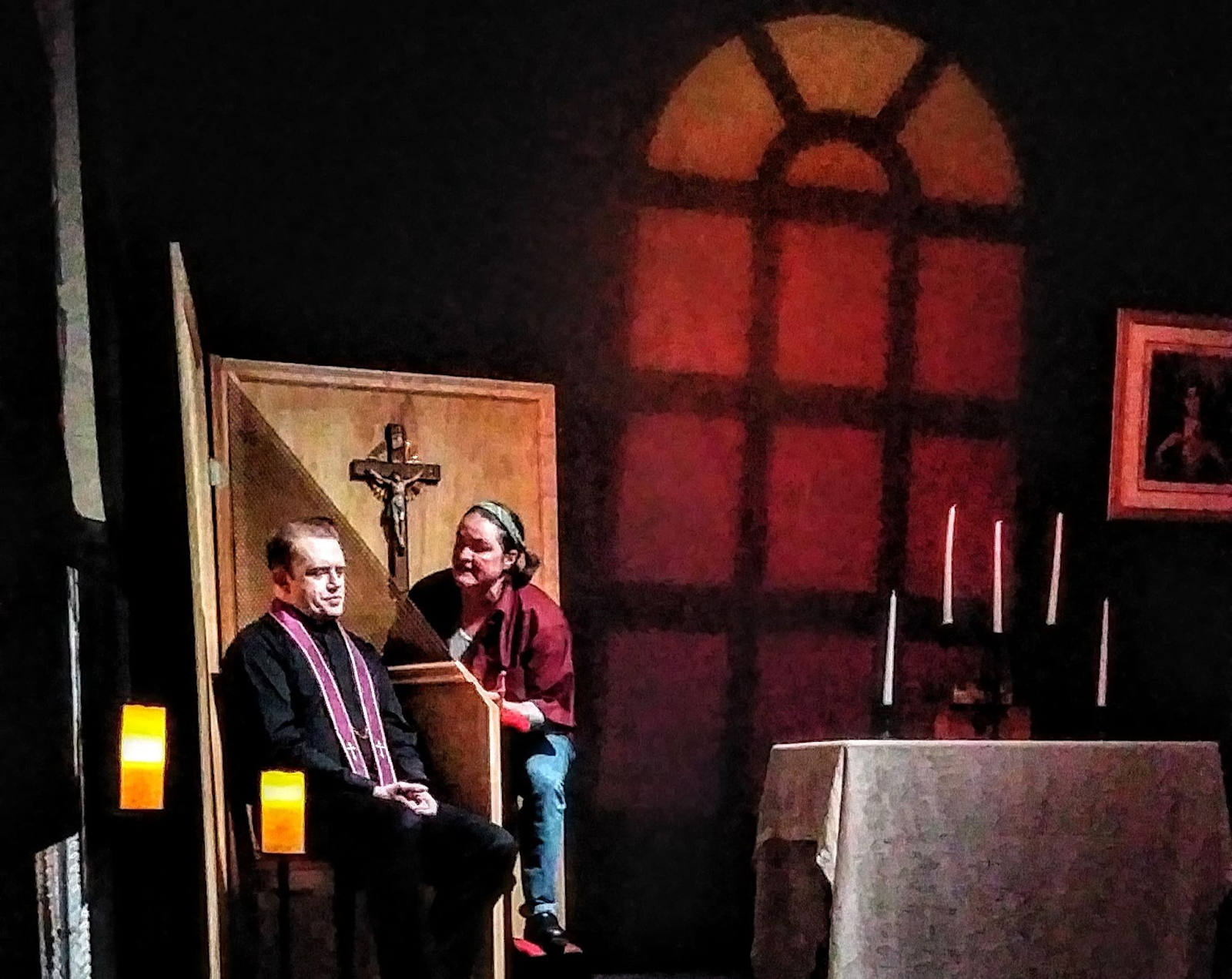
Freshwater Theatre's Immaculate Heart offers insight into negotiating Catholicism and sexuality

Image courtesy Freshwater Theatre
No matter how long its been since you have been to mass, called a parish home, or gone to confession, you never shake being a Roman Catholic.

I haven't been a church goer since 1987, but at a funeral last week, I felt myself going through the old motions, finding comfort in the familiar rhythm of the mass, even feeling that spiritual thrill that comes with the miracle of the host.

I also knew, deep inside, that the issues that drove from the church all those years ago -- matters of sexuality, priestly abuse, and the musty Medieval smell that populates much of the Catholic Church's politics -- make a return to Mother's embrace impossible.

That evening, I headed out to see Immaculate Heart, a world premiere at Freshwater Theatre that embraced all of the conflicting emotions I had felt throughout the days. Ruth Virkus' excellent new work brings these issues into play, as a woman's awakening to her long-hidden sexuality brings her into sharp conflict with the parish she has called home her entire life.

Clare is interested in living a quiet life, devoting herself to a part-time job with the parish, assisting the harried priest, Father Paul, in the nitty gritty details of the church: tidying up the sanctuary, making sure the seasonal banners are in good repair, and in general serving far beyond the demands of her job.

Outside of this, Clare's main interest comes in knitting and other needlework. It is during a class she is teaching on knitting that she meets Marina. Marina is brash, friendly, and takes an immediate shine to Clare. As their friendship deepens, Marina wonders if there is something more between them. She has been open about her past girlfriends, but Clare doesn't seem to have much of a history with dating.

It turns out that she has been on exactly one date in her life. Some more probing -- some gentle, some not -- shows us that Clare is asexual; she has never had those kinds of thoughts about another person.

Their friendship also creates conflict with Father Paul, especially after Marina visits the church (and the confessional!) to the priest's chagrin. As Clare is tossed into conflict between her longtime home and her newfound friend, she finds it increasingly difficult to negotiate a path that includes both.

While Immaculate Heart has serious issues at its core, this isn't some dour trip. There is a lot of heart and humor throughout, from the early moments of Clare and Father Paul negotiating the non-religious parts of the parish to the initially halting friendship between Clare and Marina.

That's aided by the performers, who provide plenty of humanity to each role. Noe Tallen (Marina) and Rachel Flynn (Clare) have an easy chemistry that builds a bond between the characters from the beginning. The same goes for Flynn and Scot Froelich as the priest.

Froelich may have the toughest job, as his character becomes the antagonist for both women by the end of the show. The script could have used a few more touches to deepen the reverend. There is a sense of the intense loneliness he feels as the spiritual head of the parish, but a stronger sense of the personal connection he feels for Clare would make his eventual turn all the more agonizing.

That issue aside, Immaculate Heart is an engrossing show that easily moves between matters of the heart and matters of the spirit. As with other Freshwater shows, it is being produced in rep with an associated piece. Eventually, Epiphany is a collection of works by local artists and storytellers about the lessons they've learned in adulthood. For showtimes and tickets, visit online.

Monday, July 22, 2019

Cabal: Deep secrets in plain sight

Photo by Dan Norman
Over the years, Walking Shadow Theatre Company has explored plenty of mental and physical spaces. For the latter, they've previously produced a pair of "plays with puzzles," 1926 Pleasant and Saboteur.  After a long gestation period, the company's latest, Cabal, has arrived.

Over the years, the concept behind these -- the audience teams together to solve puzzles and experience the story -- has become more familiar with the popularity of escape rooms, but Walking Shadow's distinct twist has always been more immersive. The secret? Adding an intriguing plot and characters we can care about.

In Cabal, the audience (limited to 10 people) take on the roles of initiates in a secret magical order. Being an initiate comes with great responsibilities, especially after an off-stage death sends the entire order into chaos, leaving the new crew to right the rocking ship.

In performance terms, that means we have some puzzles (designed by David Pisa) to solve. I won't go into specifics, as much of the experience is about working out fresh challenges on the spot. I will say that they all had enough layers to them to mean that the group had to work together to solve them, and that they all took some puzzling out and the occasional false step to solve. So like a Resident Evil game, without the constant threat of zombies munching on your shoulders.

While the puzzles are the main attraction, the story and characters really give Cabal its texture. As the secrets are uncovered, the play part of the show (created by John Heimbuch) delves into heavier themes, especially the concepts of sacrifice and forgiveness. (Again, specifics would give away too much of the plot.)

This is aided by the initial cast, with Jamie Case and Tara Borman offering a mixture of tight characters and the occasional gentle guidance if the team ever falters on the puzzle.

Most of all, Cabal is a singular experience, and a reminder of how flexible and unique live theater can be. The show is in an open run, but each performance can only have 10 cast members. For more information, visit online.

Friday, November 9, 2018

King Kong: Something awesome, something awful


When it’s all said and done in King Kong, the $35 million show opening this week on Broadway, the final bows – and biggest cheers – are saved for the dozen-plus performers who bring the 20-foot gorilla to life every night.

There’s no question that the show is an over-the-top spectacular whenever King Kong is on stage, whether it is battling a giant, prehistoric snake; dashing through a burning New York City with Ann Darrow on his back; or challenging a veritable fleet of planes trying to take him down from the Empire State Building.
It's the rest of the show that's such a downer.

It’s been a long journey for Kong to make it to this stage, starting a decade ago in Australia. There has been plenty of work since then, including an early version of the show produced in Melbourne in 2013.

Puppet designer Sonny Tilders took on the epic task of creating the massive marionette, which weighs in at around a ton. To bring the high-tech puppet to life requires plenty of on-stage help. A dozen performers manipulate his arms and legs, while a quartet, stationed in the off-stage “voodoo box,” control the facial features.

This also includes Kong’s voice, as one of the team handles his roars, which are enhanced to shift into the monstrous noise that comes out on stage.

The basic outline of the story has remained the same. A film crew, including young starlet Ann Darrow. head out to Skull Island. There, they find a giant monster. The monster is brought back to New York City and displayed like a circus animal. He escapes, climbs the Empire State Building with Ms. Darrow in tow. Biplanes shoot the gorilla down and we get the end.

There are differences in the details, however. Instead of being tossed between a giant gorilla and the film’s romantic lead, Ann is her own woman. In fact, there is no romantic lead to be seen.

While these changes can make for a more interesting story, their application on stage leaves plenty to be desired. Likely, it was going to be impossible for the production to top the moments when King Kong was on stage, but the rest of the show struggles to make any impression, let alone a positive one, whenever our simian friend is off stage.

Even though the creators won’t add this tag to the show, King Kong is definitely a musical. And while that could work with stronger material, the songs provided by Eddie Perfect pretty much pass in one ear and out the other.

Better is Marius de Vries’ incidental music, which blends traditional movie scores with electronic styles for sounds that help to drive the high action along.

The three human leads are also upstaged by their puppet colleague. Christiani Pitts brings some steel to Ann Darrow, but lacks the presence to take over this stage when needed. The massive set and high tech visuals swallow her up at almost every turn. The one time it doesn’t? When she has some quality time with Kong. There, Pitts clearly shows her skills as a performer, which helps to make Kong all the more real.

The same can be said for Eric William Morris (as filmmaker Carl Denham) and Erik Lochtefeld (as Denham’s assistant and Darrow’s confidant Lumpy). All three show signs that on another stage, their performances could carry the day, but they lack the outsized, operatic scale needed here.

Really, that’s the issue in a nutshell. We’re here for King Kong, and there’s too much time spent without him onstage. Obviously, you don’t want wall-to-wall monster, but a tighter, slimmer production would give us what we want without nearly as many distractions.
Photo by Bruce Silcox

Puppets of a different scale at Open Eye Figure Theatre

If you are in the Twin Cities and want to check out some puppets of a different scale, Open Eye Figure Theatre has brought back its signature piece, "A Prelude to Faust" for one final run.

First presented 20 years ago, Michael Sommers riff on the Faust legend helped to spark Open Eye as an ongoing theater. The show is loaded with the type of theatrical delights that have marked so much of Sommers' work. 

Tickets for the remaining performances are extremely limited, but the show has been extended to Nov. 18.