Thursday, August 21, 2014

Doctor Who Season 26: Ace for the win


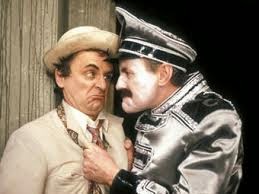
The darker Doctor Who under Sylvester McCoy continues through his final season – he even changes jackets from white to brown (alas, he is still stuck with the question-mark sweater). The season also points to some intriguing directions the show could have taken if there had been a season 27. Some of these ideas did finally come to fruition – but not until 2005.

Battlefield

Here’s a rousing start to the season, with the Doctor as Merlin, Ace as the Lady of the Lake, and the Brig coming back for one last go on Doctor Who. (Nicholas Courtney would never appear on the revised series, though his character is mentioned a few times. He would show up on the spin-off Sarah Jane Adventures.) The plot involves cross-dimensional baddies invading a small part of the English countryside, bent on destruction. There’s also a nuclear weapon for fun (and to make some less-than-subtle political points). Oh, and Bessie – the Third Doctor’s beloved roadster – makes an appearance. Yay!

Ghost Light

The rest of the year is given over to a loosely connected trilogy of “Ace” stories, allowing us to dig pretty deep into one of the Doctor’s companions. Hey, it only took 26 years to get to this point. Ghost Light travels to Victorian England and to a haunted house that frightened the young Ace so much she burned it down. 

What follows is an absolutely confounding story that involves aliens, evolution, and a lot of mucking about inside the house. The patience is paid off somewhat in interesting performances and some startling moments, but it still makes my head hurt everything I watch it and try to work out exactly what’s happening.

The Curse of Fenric

And here we get the template for the modern Doctor Who. Don’t believe me? A companion with a troubled relationship with her mother travels back in time, and meets the infant version of that mother (similar to Rose meeting her self in Father’s Day). The plot involves the time-traveling future of humanity mucking about in the past (the Master trilogy in David Tennant’s second season) trying to claim the Earth as their own. We even get a troubled historical figure, though in this case they’ve disguised that a bit. The brilliant Dr. Judson is an analog of Alan Turing, with the real scientist’s sexual orientation transformed into a crippling injury. Some things were too hot to handle in the 1980s.

Underneath the story – time traveling future humans attacking a community in World War II Britain – is Ace, who confronts not only her own past and relationship with her mother, but her very faith in the Doctor. To eventually defeat the baddies, the Doctor has to break Ace’s faith in him. It’s a terrifying, heartbreaking moment – but one that allows Ace to be stronger on the other side. There’s even a final, cleansing swim to wrap it all up.

Survival

And here’s the end that, like so many stories in this era, is a collection of good ideas shortchanged by execution. Let’s take care of the troubles first. This is a story about alien cat predators kidnapping youth in Ace’s hometown for a hunt. They aren’t frightening. Instead, the faux fur costumes make them look like rejects from a Puss in Boots convention. Then there’s an animatronic cat that is convincing for a millisecond. Sadly, it’s on screen for long stretches of time (the real cats hired for the series turned out to be too finicky and refused to cooperate on camera).

If you can look past all of that, there’s plenty to like. The script, by playwright Nona Munro, shows a sophistication, reality and depth rarely seen in the original run of the program (another way this season presages the revival). Ace’s journey wraps up back in her dull London home, and she is able to not just cope but help her surviving friends escape their cat trouble. There are good guest performances throughout. And the Master shows up for the first time in years, in a new muted costume and a performance that was a bit less than over the top from Anthony Ainley.

Knowing that the show was unlikely to return, the producers were able to slip a final speech for Sylvester as a voice over at the end, giving him better final lines than poor Colin Baker (“carrot juice”):

There are worlds out there where the sky is burning, and the sea's asleep, and the rivers dream. People made of smoke, and cities made of song. Somewhere there's danger, somewhere there’s injustice, and somewhere else the tea's getting cold. Come on, Ace — we’ve got work to do!

Next time: the 16-year wait, or “why is Eric Roberts playing the Master?”

Tuesday, August 19, 2014

Doctor Who Season 25: "I've even got your socks"

Doctor Who may have died a slow death at the tail end of the 1980s, but that doesn’t mean there weren’t folks working their tails off to make the best show they could under extreme circumstances. This included writers will to take chances, directors pushing the limitations of 1980s British TV, and the two regulars (Sylvester McCoy and Sophie Aldred) willing to examine the depths of their characters.

A key cog to all of this was script editor Andrew Cartmel, a young turk who was interested in both returning the Doctor to his roots and pushing the show forward. A lot of the trapping that had marked the last decade of the show disappeared. The Time Lords were never seen during these years. Most of the stories introduced new villains and monsters. The Doctor took a decided turn to the dark side.

Not all of it worked, but the last two seasons are certainly the most intriguing of the entire decade.

Remembrance of the Daleks

A lot of the innovations “introduced” in the revised series can trace their roots these McCoy episodes, including several moments here. The most iconic – well, it would be if anyone would bloody well remember it – is the levitating Dalek finally working its way up a flight of stairs in pursuit of the Doctor.

This a glorious story from beginning to end. The Doctor is seriously bad ass (he essentially destroys Skaro at the end; hope the Thalls have moved to a better neighborhood), as is Ace, who takes out a pepperpot with a turbocharged baseball bat.

It’s also an anniversary episode, with the action taking place a few weeks after the events of An Unearthly Child. We return to the Coal Hill School (with a book about the French Revolution sitting there in the chemistry lab) and even the original junkyard (though misspelled here; oops).

Beyond that, the story of competing Dalek forces – and fascists on the ground – returns us to the themes that Terry Nation brought forward in the very first Dalek episode. Even the unnecessary presence of Davros doesn’t ruin it.

The Happiness Patrol

This is probably the most controversial serial in the classic series, mainly down to the strange brightly-colored robot, The Kandy Man, and the not-all-that-veiled references to Margaret Thatcher and late 1980s politics.

In a nutshell, Terra Alpha is a place where being sad is illegal. Lovers of walks in the rain and the blues are carted off to be re-educated or worse. The Doctor and Ace arrive in this surreal situation and proceed to muck it up, tearing down the government over the course of a long night.

The story and acting are fine, but the design eventually lets down its side of the bargain. This is a show that screams for a completely surreal look (Terry Gilliam’s Brazil has been mentioned as an inspiration) that just doesn’t come to life.  It’s a shame, as it is a perfect example of McCoy’s Doctor otherwise, quietly manipulating people to do his bidding and to come out with the solution he wanted all the while.

Silver Nemesis

While the Time Lords are thankfully absent in the Sylvester McCoy era, Time Lord lore is not. In fact, there was an extensive back story that made the Doctor the third leg of the society, along with Rassilon and Omega. Little of this came through in Silver Nemesis (though it did play a part in later Virgin New Adventure novels), but the sense of the Doctor as a very powerful being did. In fact, author Kevin Clarke worked with the unsaid assumption that our hero was actually God.

Now, I don’t think this is a good way to go for any adventure story – an all-powerful creature isn’t really all that dramatic – but it does play into the worker-behind-the-scenes vibe of this season. Here, he has a troupe of Cybermen, some neo-Nazis, and a time-traveling witch that he can play off each other. It ends with more mass destruction, as an entire Cyber fleet gets offed in a particularly bad special effect. The whole thing falls apart in the final episode, but it had been a good ride up until that point.

The Greatest Show in the Galaxy

This doesn’t get off to a good start, as we have the Ringmaster of the Psychic Circus doing a little tap dance – and then rapping. Rapping was never good on TV in the 1980s (or really that much since) and especially not on British TV.

The story does get better, but there are moments when the ambition of the story can’t match the limitations of the time. In a series always one step from the abyss, this serial was particularly fraught. After location filming was done, their studio was shut down because of asbestos. The production team improvised, hired a tent and shot the rest of it in a parking lot. That stress shows through, but there are some strong bits here, from delving deeper into Ace’s background to an on-screen fanboy who proudly declares that he even has a pair of Psychic Circus socks (note: I have three pairs of Doctor Who socks).

It also gives McCoy a chance to show off his clowning skills. In the finale, he faces off with the Gods of Ragnarok, ancient deities who thirst for continual entertainment. He holds them off long enough for his plan to come to fruition, saved by Ace, a werewolf girl and the remaining circus denizens.


Disaster averted once again, the series was ready to head off for a new season. Everyone was unaware this would be the last.

Monday, August 18, 2014

Doctor Who Season 24: Our hero, the fool

The Sylvester McCoy era gives us a new version of the title theme and a new, computer-aided credit sequence. It’s the best we’re going to get from the show for a bit. Why, because the season opens with…

Time and the Rani

Pip and Jane Baker finish their trilogy of terror with a particularly pointless adventure centered on kidnapping brilliant minds from across the galaxy for a nefarious plot so uninteresting that I don’t even remember the details a short time after seeing the episode. Mel screams a lot (I mean, a lot; she could break glass) and we have some rather noble looking guest actors forced to be extremely silly as the sad-sack aliens (really, the Rani should dominate these losers).

And then there’s McCoy. He has far from an auspicious start, as the fired Colin Baker (rightfully so) refused to return for a regeneration episode. So… Syl puts on a curly wig and slips into the Technicolor vomit coat and plays Doctor #6 for a few moments, regenerating after apparently falling down in the Tardis (concussions are a danger, but still…)

It doesn’t get much better as the show develops. McCoy spends the first series – much of the first season really – finding the balance for his character. What eventually comes from this – a comedic surface that hides a real darkness – is brilliant. It isn’t there yet. Instead, we get lots of maliprops, the first appearance of the spoons, and just a lot of clowning. It’s enough to make you want to scream – but not like Mel, never like Mel.

Paradise Towers

The second outing is better, in part because author Steven Wyatt used a J.G. Ballard novel (High Rise) as inspiration. The decaying housing tower is full of plenty of oddities, from the young women who have arranged themselves into gangs (“Red Kangs, Red Kangs, Red Kangs are best!), to the elderly “rezzies” who are looking for a good meal – which would include Mel on the dinner plate.

This gets let down in key areas. First, the props and effects are definitely not “special,” with a stunningly feeble monster robot thing that wouldn’t scare the world’s most skittish mouse. Then there is Richard Briers, who turns in truly one of the worst guest turns ever on Doctor Who, stripping really any kind of menace from the script.

McCoy improves here, toning down the performance a bit (just a bit) and showing some Troughton-like tendencies. And his tipping his hat to a water-pump-like thing with a quick “you never know” still makes me laugh.

Delta and the Bannermen

Nothing makes me laugh in this tone deaf disaster, loaded with bad versions of ‘50s rock tunes, badly done American secret-service agents, bad intergalactic tourists, and a bunch of heroes who all go green by the end (not in a recycling or Hulk kind of way either). Basically, space tourists land on Earth in the 1950s. Spend time at a Welsh holiday camp. Bad guys arrive, kill all the tourists and eventually get defeated by the Doctor and the green brigade. Did I mention this is played for fun? Yep, a show where dozens of innocents are disintegrated is mostly played as a farce. Gah.

Dragonfire

Two significant things happen here. First, we lose Mel (hurray!) and we gain Ace (double hurray!). There are some things of interest in Mel’s backstory (she was a computer programmer, you know), but Bonnie Langford was never particularly convincing and her chemistry with McCoy was nil. There was the screaming, too, but I just don’t want to think about that anymore.

Ace was everything Mel was not. Cool. Modern. Tough. Angry. Ace never met a problem that couldn’t be solved with explosives. Her first outing showcases all of that, as she gets ensnared with the Doctor, Glitz (back for one more go), and a search for an ancient treasure.

The episode also has – uniquely among the 24th-season episodes – a convincing villain. As Kane, Edward Peel plays the role as cold as the subzero environment the character needs to survive. His temptation of Ace makes for a compelling early scene, while his backstory has enough pathos in it to make the character truly compelling.


At story’s end, Mel goes off with Glitz (for no reason really, except they needed to get the character out of the way) and Ace joins the crew. We’re ready for an anniversary season – and the best one the show has seen for quite some time.

Tuesday, July 29, 2014

Doctor Who Season 23: The Junkyard will now speak for the prosecution

The Trial of a Time Lord opens with an impressive computer assisted model shot, as the camera swoops over a space station, and then shows us a tractor beam that has captured the Tardis. That’s as good as it gets during the next 14 episodes. The show came back from its hiatus with a poorly considered story arc involving the Doctor’s trial for interference lead by the black-clad Valeyard (Michael Jayston; the best thing about the entire season, even if he does wear an embarrassing hat throughout).

Of course, John Nathan-Turner and Eric Saward were still in control, which didn’t bode well for the season as a whole. The “trial” concept was meant as a commentary on their own “trial” by the BBC. This kind of insider baseball rarely works, because the vast majority of folks watching just want to have adventures. From a storytelling perspective, the trial mainly served to stop the action whenever it started to get interesting. The tone is all wrong, the Time Lord costumes are – as always – a disaster. The ratings certainly reflected the general disinterest in the series. The show came back to its worst numbers (under 4 million per episode) in its history, though they did eventually stabilize around 5 million.

The Mysterious Planet

Alas, Robert Holmes ends his nearly two-decade relationship with Doctor Who with a less than stunning script. It involves a mysterious Earth-like planet that turns out to be Earth. A typically crazy robot/computer thing, and warring factions of descendants from a high technology society (think The Face of Evil, but with the wrong Baker and no Leela). On the upside, Holmes’ wit is intact, as we get one last great double act, led by the rascal trader/pirate Glitz.

Mindwarp

Writer Philip Martin returns for best of the Trial storylines, and we get Brian Blessed being Brian Blessed. More horses! The lizard-like Sil returns, and is joined by another of his race (played, in heavy makeup, by Mike from The Young Ones), who plots to transfer his consciousness into another body. There is a lot of corridor running and near escapes, but the story moves at a strong pace and lots of danger. It also ends with perhaps the biggest downer in Doctor Who history, as Peri has her mind wiped and replaced by the evil fish thing. Really, Peri’s had the worst time on the Tardis this side of Katarina.

Terror of the Vervoids

Oh great, Pip and Jane Baker are back in this story that’s a lot like Nightmare in Eden – only
worse. And we get Mel, a companion that is somehow more annoying that Peri. This time out, it’s killer plants on a space liner who are about to kill everything if they escape. Arrayed against the Doctor are some bad scientists, led by an underutilized Honor Blackman. At story’s end, the Doctor kills all of the Vervoids, and gets accused of... genocide! Cue ending credits. And then watch that particular plot thread get dropped in the series finale.

The Ultimate Foe

The finale feels like the work of two different writers – because it is. Actually, there are four writers involved here. Robert Holmes started it, but fell ill and died after completing most of episode one. Eric Saward took over, completed that episode and wrote the second part according to Holmes’ outline. Saward and JNT had a falling out over the ending (involving the Doctor and the Valeyard locked in mortal combat for a cliffhanger), which lead the author to withdraw his script. Pip and Jane (oh no!) Baker were brought in to finish it, but were not allowed to even glance at Saward’s work, but had to use the sets established in that part. In other words, it’s a mess. The Valeyard is revealed to be the evil distillation of the Doctor, out to get his remaining regenerations. The moment is dropped by the Master (oh no!) as a casual aside, like “Hey Doctor. Hey Evil Doctor. What’s up?”

The Valeyard’s plot revolves around something called the Megabyte Modem, so apparently he  wants to bring internet access to the universe and destroy society with Twitter and Instigram. He gets stopped and all is well. Even Peri turns out to be alive, robbing the season of its most powerful moment. And Colin Baker’s last line in the role? “Carrot juice.”

At the end of this season, Baker was fired. John Nathan-Turner was still stuck on the show, and the worst season of the show’s history was, well, history. I wish I could say this lead to a renaissance, but the bad times would continue to roll when Sylvester McCoy took on therole (though it will get better).

Monday, July 21, 2014

Doctor Who Season 22: Change isn't always for the good

Let me say at the outset that I really like Colin Baker as a performer and his interpretation of the Doctor was loaded with potential. It took a couple of decades – and the efforts of the Big Finish audio
dramas – to finally bring that to fruition. His era on the actual program was fraught – haunted? destroyed? – with troubles, as John Nathan Turner’s excesses (and the BBC’s ever-tightening budget)
threatened to kill the long-running show.

The Twin Dilemma

Colin Baker’s first entry on the show was actually part of the previous season, so viewers went from the high of The Caves of Androzoni to… this. The quality of acting went down steadily during
the JNT years, and this is a prime example. Lots of stiff acting across the board, with the best actor trapped in a rather preposterous costume. The story doesn’t make a lot of sense. Then there’s the
Doctor’s behavior. The regeneration – as usual – as gone badly. This time, he ends up being vain, angry and violent. He even tries to kill Peri at one point. Even as the Doctor “improved,” the relationship between him and the companion never recovered from that. He was always cutting and
bitchy; she complained all the time (though after nearly being choked to death, she had cause). Not fun at all.

Attack of the Cybermen

Colin Baker’s first proper season starts off with a bang, with the return of an old nemesis, ex-Dalek agent Lytton, and a trip deep into the show’s history. It doesn’t hold together all that well, and the
senseless violence begins to grate on the nerves. Part of the problem is that the show is steeped in Cybermen history, with references back to The Tomb of the Cybermen and The Tenth Planet (the first was thought lost at this time; the second was incomplete and had not aired in 20-plus years). These weren’t stray lines dropped here or there, but long info dumps that ground the adventure to the halt. And then we get the original inhabitants of Telos, who were thought to be exterminated by the Cybermen. The costume design looked like something from William Hartnell’s era (well, the budget was about the same). There’s also some senseless killing, as the three characters involved in a subplot to escape from Telos as gunned down within a few feet of their target. Gah, the gritty ‘80s were terrible in so many ways.

Vengeance on Varos

Speaking of gratuitous violence. This opens with Sean Connery’s son, bare chested, obviously being tortured. From there, we see a type of democracy where a negative vote mean the leader’s death; old cannibals in baggy underpants; and death by acid bath. Though infamous for all of this, Vengeance on Varos is actually one of Colin Baker’s best outings. The work of author Philip Martin helps a bunch, as does the satiric tone that – for once – matches Colin Baker’s approach to the role. We also the get the delightfully slimy (literally, he’s an amphibian type creature) Sil, who is sort of like a Ferengi without
the positive aspects.

Mark of the Rani

The team of Pip and Jane Baker scarred this era of Doctor Who with their terrible scripts, starting with this one. The Rani is another renegade time lord, who has stopped off in pre-industrial England to
do a bit of experimentation. The Master is there as well. People get turned into trees. The saving grace? It’s not Time and the Rani.

The Two Doctors

Oh, what a terrible waste. Patrick Troughton and Fraiser Hines make their return to the show, as do the Sontarans. We even have a Robert Holmes script. What could go wrong? Well, just about everything in
this overlong and overcooked turkey. Holmes’ story might have worked as a normal 90-minute adventure, but stretching it out to the equivalent of six episodes (they were 45 minute episodes during this season) means the final part is pretty much all filler. Troughton does his best to bring some old-school charm to the proceedings, but the ugly nature of the story (one character gets killed primarily for the shock value; both Peri and Jamie are threatened with ending up on the dinner table) makes it an
uncomfortable and unpleasant watch.

Timelash

You know when the biggest surprise is that the Victorian gent “Herbert” who has joined the Doctor for this adventure is obviously H.G. Wells that the script isn’t working. This brings back plenty of
bad memories from The Horns of Nimon, without the campy and relatively fun lead performances. That’s right, I’d rather watch The Horns of Nimon than this.

Revelation of the Daleks

At least, the season ends on a relative high – and probably Colin Baker’s best aired adventure. That is definitely relative, as this tale has odd pacing and an uneven Eric Saward script. What we do have,
however, is some terrific Grahme Harper directing, who infuses plenty of energy into the proceedings. We also have two warring factions of Daleks – who are fighting for Davros’ head in a jar. Clive Swift (best known as Richard on Keeping Up Appearances) is delightful as a somewhat crazed and vain mortician, while Alexi Sayle gets to be Alexei Sayle.

After the airing of season 22, Doctor Who was cancelled… and then reverted to an 18-month hiatus. Looking back at this season, I would have done the same thing if I had been in control of the BBC (oh, the power). This was a complete disaster of a season in terms of tone, performances, scripts, effects, directing and overall quality. Of course, I would have also purged the production team. That didn’t
happen, which contributes to the ultimate nadir of 26 seasons of the original Doctor Who. In place of the planned 23rd season (which would have included the return of the Celestial Toymaker!) we got (shudder) The Trial of a Time Lord.

Friday, July 18, 2014

Doctor Who Season 21: Caves, Daleks and a pantomime horse


After a shaky start, Peter Davison’s final season ends with one of the best stories of any era. Still, the stress is showing on the show, as the transition into the 1980s made for an uneasy era.

Warriors of the Deep

This is a pretty tense, base-under-attack adventure (ala the Patrick Troughton years) – until the monster pantomime horse shows up. That’s right, the big monster used by the combined forces of the Silurians and the Sea Devils was played by a pair of guys who normally were the front and back ends of a horse on a British comedy program. The adventure never really recovers, and the epic bloodletting that will
be the hallmark of the coming seasons gets off to a roaring start here, as pretty much everyone is dead (certainly all the Silurains and Sea Devils) by story’s end and leaving Peter Davison with his classic closing line, “There should have been another way.”

The Awakening

Two-part adventures were always an awkward fit for the Doctor Who format. These increased pace and tighter direction means that the modern-day adventures mostly have the same running time, but often didn’t have the weight to even carry two episodes of an adventure. The Awakening, on the other hand, really could have used a third episode, because the odd tale of time travel and English Civil War reenactments gone way, way too far really could have used some more time to flesh out the action. There are still good moments throughout here, including a nicely realized stone-face monster thing.

Frontios

The Visitation could have easily taken one of the episodes here. There is at least 25 minutes of  walks along the BBC corridors that could have been cut and not affected the story one whit. It’s a shame, as there’s some in this adventure. First off, we get a little more context for Turlough. Mark Strickson was a fine performer with an interesting look who never really had much to do except be a coward.
Here, there is some tension about his nature, as the villains of this piece (called Tractators; they have epic gravity powers) are buried deep in his previously barely mentioned alien race memory. The Tractactors themselves are pretty daft, as the limitations of the budget come home to roost with these big mollusks.

Resurrection of the Daleks

You shouldn’t get attached to any of the characters in this adventure, because they aren’t going to last long. The Daleks’ return opens with a group of escaping prisoners being gunned down by a pair of London Bobbies. The bloodletting only gets more intense from there, as characters are brought in mainly to be slaughtered – be they on then-contemporary Earth, on a Dalek spacecraft or a space station that guards the vilest prisoner in the cosmos: Dalek creator Davros. We also have a turncoat human working for the Daleks; an awesome cold-hearted bastard (Lytton, he’ll be back) working for the Daleks; and Peter Davison emptying a revolver into a Dalek mutant. By the end, poor Tegan has seen enough and decides to stick it out on Earth. That means, of course, that a new companion is in order…

Planet of Fire

I haven’t talked much about the directing during this era, but one of the reasons the adventures often feel like slogs is static, uninteresting direction. This isn’t necessarily the fault of the people behind the cameras. While the filmed segments were shot, well,like films – with a single camera used and multiple takes needed to cover each scene. The studio still used the format that had been there
since the beginning of the show – five or six cameras shooting the action as “live,” with a mix of these shots used as the foundation for editing and effects. Basically, it’s a set up designed to drain any life and excitement out of a show unless the director forces the action and works to be innovative. Time usually didn’t allow for much of that, and that hurts the studio side of Planet of Fire.

The filmed segments – shot in Lanzarote – do a nice job of bringing the titular planet to life, while the script itself does a lot of cleaning up and place setting for the end of the Davison era. This means Kamilion (remember, the robot locked in a closet) makes his return, though mostly played by an actor in silver makeup. Turlough finally meets up with his people and we learn more about his background – and he even gets to grow a spine at last. And then there’s Peri. JNT wanted an American companion for the American audience, not realizing that we – of course – could watch Americans on TV all the time. That the British Nicola Bryant wasn’t always convincing (she got better over her run) and her
character whined her way through the adventure (this never improved) certainly didn’t help. Oh, and the Master was around – and he was laughably tiny (a lab accident), which brought back unfortunate memories of William Hartnell’s Planet of Giants adventure.


The Caves of Androzani

In the late Aughts, this episode was named the best all time of the program in a survey of fans. I wouldn’t go that far (I’m partial to Pyramids of Mars myself) but it is light years beyond anything else done in the 1980s. Why? Well, Robert Holmes returns for the first time in years and gives us a typical Bob Holmes script, loaded with conflict, skuzzy-but-intriguing characters, and a tough, sardonic wit. We get an absolutely terrific “villain,” Sharaz Jak, who looks like a mix of Diabolique and a rubber-fetish enthusiast. Most importantly, we get Graeme Harper’s first go-round as director. While the show is still studio bound, it bursts with plenty of energy as Harper uses every tool in the limited BBC book to bring the story alive. We even learn what the damn celery was all about. Best of all, this isn’t a story about saving the galaxy or even a planet. Instead, it – like the earliest stories of the show – finds the Doctor and Peri quickly ensnared in a plot happening far over the heads. They are just trying to survive, and any good they may do is just incidental.

Then with a flash, the Peter Davison era is over. Enter Colin Baker – and the terrors of the next two seasons.

Sunday, July 13, 2014

Doctor Who Season 20: Hi, Pat, Jon, fake Bill and outtake-only Tom!

It’s another birthday year, which will end with The Five Doctors special (which happened to be the first time I saw William Hartnell and Patrick Troughton on the program; and a first for Jon Pertwee doing more than regenerating into Tom Baker). It’s also when Davison decided that three years would be enough – and considering some of what is to come, it’s hard to fault the decision.

Arc of Infinity

JNT wanted to film out of Britain again (following City of Death) and found that the BBC had a connection with Amsterdam. So… this adventure has plenty of shots letting us know, beyond the shadow of a doubt, that we were in Holland. The story’s plot centers on Omega – the guy from the antimatter universe in The Three Doctors – attempting to break free again. This involves a complex plot to take over the Doctor’s essence. This leads to plenty of Time Lord politics (sound of paint drying) and corridor crawls that still manages to be more fun than it should. Some of that comes from an unexpected source: future Doctor Colin Baker, who plays an overbearing Time Lord officer (complete with highly plumed hat) who menaces Doctor and Nyssa to great effect.

Snakedance

It’s Kinda part two, as we get a return engagement with the Mara. This is quite a sophisticated adventure that leaves some work to be done by the audience (thought not as much as Kinda) and offers a really intriguing story that is full of interesting characters and generally solid performances. The special effects are a bit more special this time around as well.

Mawdryn Undead

If this episode was the length of a modern-day adventure (45 minutes) or even an hour, it would be a terrific adventure. At 90 minutes, it gets dragged down by some horrible BBC corridor padding that threatens a good idea for a story and some welcome returns. This includes the Black Guardian – now with a bird on his head – who has enlisted the aid of a youngish public school student, Turlough, in a plot to kill the Doctor. Turlough isn’t exactly as he seems (we learn about his origins later), and one of his teachers is the good ole Brigadier. As it turns out, we get two Nick Courtney’s here, one in 1977 and one in 1983. The Mawdryn of the title is one of eight people who, in ancient times, stole Time Lord technology in an attempt to find the secret of eternal life. They were doomed to constant mutations and forced to travel the universe like the Flying Dutchman. The Doctor and crew get ensnared, with the Brig and Turlough in tow. It all goes well until the two Nick’s spend most of the final episode wandering different parts of the alien ship, slowly dragging the action down.

Terminus

Mawdryn Undead was flawed. Terminus is a few good ideas (from Warriors’ Gate scribe Stephen Gallagher) wrapped around terrible execution. What’s good? There’s a faceless corporation exploiting the victims of a deadly disease on an ancient spaceship. There are some interesting performances and a mixture of interesting and unfortunate costume choices (a pair of space pirates look like they are extras in a Flock of Seagulls video). The rest is a disaster. Turlough still wants to kill the Doctor, so he and Tegan spend most of their time locked in a cupboard (really, like for almost the entire serial). Nyssa gets the disease and then meets up with a giant dog creature thing that looks like it rolled out of a space-age panto. And… really, the Black Guardian is around a bit, and then it all ends OK – and Nyssa decides to stay, mainly because they decided once again that there were two many companions.

Enlightenment

Thankfully, the Black Guardian episodes end with a bang in this intriguing adventure. The only dodgy element are some of the early 1980s special effects. The Doctor and crew land on what they think is an Edwardian racing ship. It is – sort of. The ship is actually a space-going vessel, as a group of “Eternals” are involved in a race. Their prize is “enlightenment.” The Eternals can’t feel emotions, so they use folks like us to live and experience emotions. As our crew is ensnared, Turlough goes through a final battle of wills as he works his way through the Black Guardian’s final plans to destroy the Doctor. A nice script, great guest cast and a terrific visual look carry the day here.

The King’s Demons

So, it’s months before the signing of the Magna Carta and…Ugh. I would rather watch Time-Flight on a loop for 12 hours than spend another 45 minutes with this… thing. Essentially a two-episode excuse to introduce a new companion, the story is dull, annoying and ultimately awful. Anthony Ainley is absolutely unconvincing in disguise, the historical setting is poorly realized (though we do get Ilsa Blair, which is nice) and then there is Kamelion. Apparently, JNT saw a demo of a prototype robot and decided he wanted one for the show. As it turned out, the robot never worked properly – it could move a little bit, but never in any convincing fashion. It certainly was unable to walk. After this, Kamelion spent most of his time in a cupboard in the Tardis until finally meeting an end in Peter Davison’s final episode. That, however, is still a year away…

The Five Doctors

This was filmed as part of the 20th season, but actually was a special 90-minute adventure. It was broadcast on Nov. 25, 1983, two days after the show’s 20th anniversary. While the term didn’t exist then, this is essentially fan service. All of the actors are represented, though William Hartnell was only seen in a clip from one of his episodes; while Tom Baker refused to take part, so footage from the unfinished Shada was used instead.

Along with Davison, Troughton and Pertwee (and Richard Hurndall, who nicely channels Hartnell as the First Doctor), we have favorite companions (Susan, the Brig and Sarah Jane), along with the Master, Cybermen, a Dalek and a few other cameos. Alas, we also have Time Lord politics again, this time centered on the Death Zone, the tomb of Rassilion, and more corruption. The story barely holds together (Terrance Dicks had to sub in at the last minute for Robert Holmes and assembled it on the fly) and the effects aren’t always all that special… but this was a favorite of the teenage me, especially for the peek into the then unseen early era of the program.

Up next, the Davison era ends with a stunning high – but not before a couple more terrible lows.