Thursday, September 19, 2019

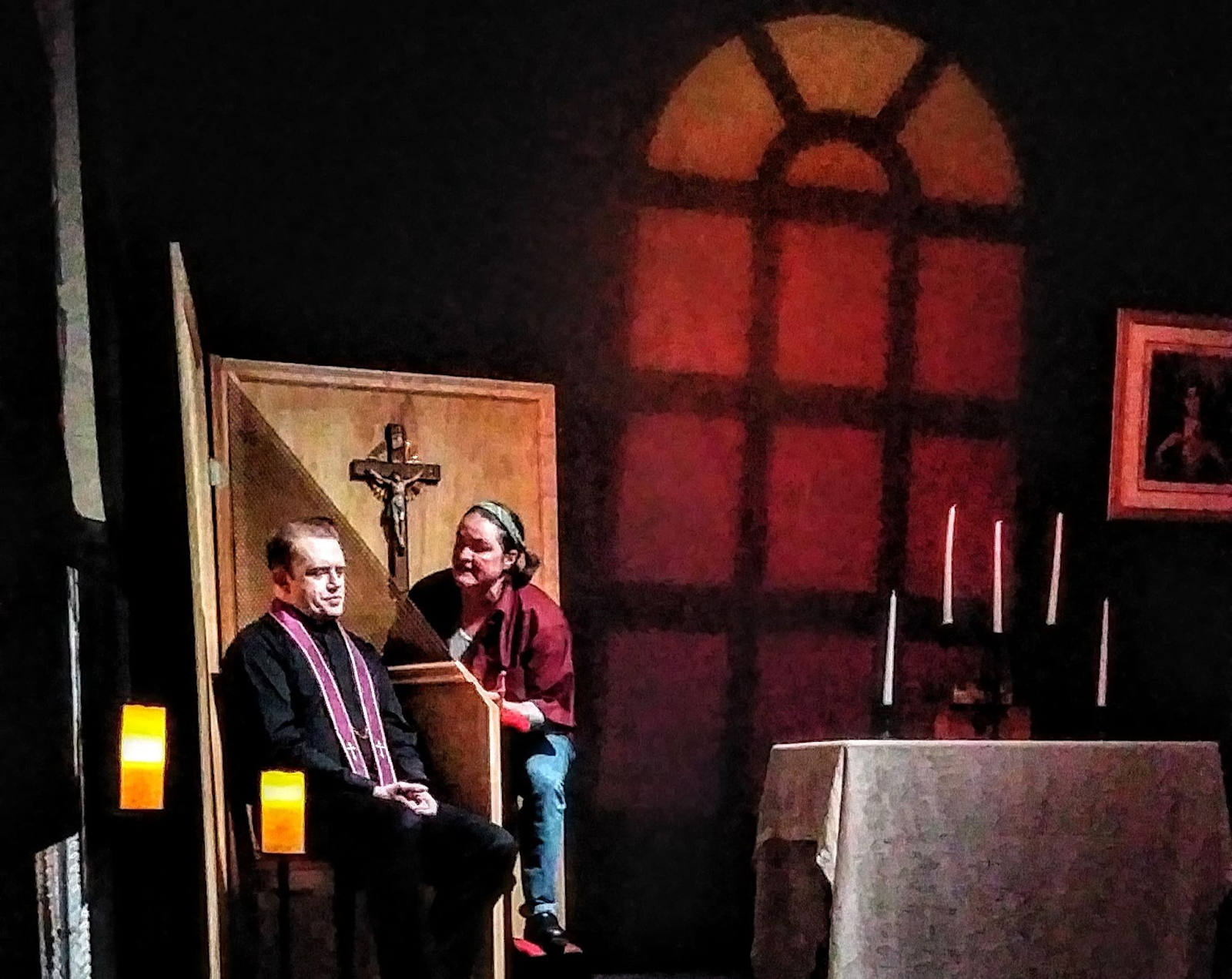
Freshwater Theatre's Immaculate Heart offers insight into negotiating Catholicism and sexuality

Image courtesy Freshwater Theatre
No matter how long its been since you have been to mass, called a parish home, or gone to confession, you never shake being a Roman Catholic.

I haven't been a church goer since 1987, but at a funeral last week, I felt myself going through the old motions, finding comfort in the familiar rhythm of the mass, even feeling that spiritual thrill that comes with the miracle of the host.

I also knew, deep inside, that the issues that drove from the church all those years ago -- matters of sexuality, priestly abuse, and the musty Medieval smell that populates much of the Catholic Church's politics -- make a return to Mother's embrace impossible.

That evening, I headed out to see Immaculate Heart, a world premiere at Freshwater Theatre that embraced all of the conflicting emotions I had felt throughout the days. Ruth Virkus' excellent new work brings these issues into play, as a woman's awakening to her long-hidden sexuality brings her into sharp conflict with the parish she has called home her entire life.

Clare is interested in living a quiet life, devoting herself to a part-time job with the parish, assisting the harried priest, Father Paul, in the nitty gritty details of the church: tidying up the sanctuary, making sure the seasonal banners are in good repair, and in general serving far beyond the demands of her job.

Outside of this, Clare's main interest comes in knitting and other needlework. It is during a class she is teaching on knitting that she meets Marina. Marina is brash, friendly, and takes an immediate shine to Clare. As their friendship deepens, Marina wonders if there is something more between them. She has been open about her past girlfriends, but Clare doesn't seem to have much of a history with dating.

It turns out that she has been on exactly one date in her life. Some more probing -- some gentle, some not -- shows us that Clare is asexual; she has never had those kinds of thoughts about another person.

Their friendship also creates conflict with Father Paul, especially after Marina visits the church (and the confessional!) to the priest's chagrin. As Clare is tossed into conflict between her longtime home and her newfound friend, she finds it increasingly difficult to negotiate a path that includes both.

While Immaculate Heart has serious issues at its core, this isn't some dour trip. There is a lot of heart and humor throughout, from the early moments of Clare and Father Paul negotiating the non-religious parts of the parish to the initially halting friendship between Clare and Marina.

That's aided by the performers, who provide plenty of humanity to each role. Noe Tallen (Marina) and Rachel Flynn (Clare) have an easy chemistry that builds a bond between the characters from the beginning. The same goes for Flynn and Scot Froelich as the priest.

Froelich may have the toughest job, as his character becomes the antagonist for both women by the end of the show. The script could have used a few more touches to deepen the reverend. There is a sense of the intense loneliness he feels as the spiritual head of the parish, but a stronger sense of the personal connection he feels for Clare would make his eventual turn all the more agonizing.

That issue aside, Immaculate Heart is an engrossing show that easily moves between matters of the heart and matters of the spirit. As with other Freshwater shows, it is being produced in rep with an associated piece. Eventually, Epiphany is a collection of works by local artists and storytellers about the lessons they've learned in adulthood. For showtimes and tickets, visit online.

Monday, July 22, 2019

Cabal: Deep secrets in plain sight

Photo by Dan Norman
Over the years, Walking Shadow Theatre Company has explored plenty of mental and physical spaces. For the latter, they've previously produced a pair of "plays with puzzles," 1926 Pleasant and Saboteur.  After a long gestation period, the company's latest, Cabal, has arrived.

Over the years, the concept behind these -- the audience teams together to solve puzzles and experience the story -- has become more familiar with the popularity of escape rooms, but Walking Shadow's distinct twist has always been more immersive. The secret? Adding an intriguing plot and characters we can care about.

In Cabal, the audience (limited to 10 people) take on the roles of initiates in a secret magical order. Being an initiate comes with great responsibilities, especially after an off-stage death sends the entire order into chaos, leaving the new crew to right the rocking ship.

In performance terms, that means we have some puzzles (designed by David Pisa) to solve. I won't go into specifics, as much of the experience is about working out fresh challenges on the spot. I will say that they all had enough layers to them to mean that the group had to work together to solve them, and that they all took some puzzling out and the occasional false step to solve. So like a Resident Evil game, without the constant threat of zombies munching on your shoulders.

While the puzzles are the main attraction, the story and characters really give Cabal its texture. As the secrets are uncovered, the play part of the show (created by John Heimbuch) delves into heavier themes, especially the concepts of sacrifice and forgiveness. (Again, specifics would give away too much of the plot.)

This is aided by the initial cast, with Jamie Case and Tara Borman offering a mixture of tight characters and the occasional gentle guidance if the team ever falters on the puzzle.

Most of all, Cabal is a singular experience, and a reminder of how flexible and unique live theater can be. The show is in an open run, but each performance can only have 10 cast members. For more information, visit online.

Friday, November 9, 2018

King Kong: Something awesome, something awful


When it’s all said and done in King Kong, the $35 million show opening this week on Broadway, the final bows – and biggest cheers – are saved for the dozen-plus performers who bring the 20-foot gorilla to life every night.

There’s no question that the show is an over-the-top spectacular whenever King Kong is on stage, whether it is battling a giant, prehistoric snake; dashing through a burning New York City with Ann Darrow on his back; or challenging a veritable fleet of planes trying to take him down from the Empire State Building.
It's the rest of the show that's such a downer.

It’s been a long journey for Kong to make it to this stage, starting a decade ago in Australia. There has been plenty of work since then, including an early version of the show produced in Melbourne in 2013.

Puppet designer Sonny Tilders took on the epic task of creating the massive marionette, which weighs in at around a ton. To bring the high-tech puppet to life requires plenty of on-stage help. A dozen performers manipulate his arms and legs, while a quartet, stationed in the off-stage “voodoo box,” control the facial features.

This also includes Kong’s voice, as one of the team handles his roars, which are enhanced to shift into the monstrous noise that comes out on stage.

The basic outline of the story has remained the same. A film crew, including young starlet Ann Darrow. head out to Skull Island. There, they find a giant monster. The monster is brought back to New York City and displayed like a circus animal. He escapes, climbs the Empire State Building with Ms. Darrow in tow. Biplanes shoot the gorilla down and we get the end.

There are differences in the details, however. Instead of being tossed between a giant gorilla and the film’s romantic lead, Ann is her own woman. In fact, there is no romantic lead to be seen.

While these changes can make for a more interesting story, their application on stage leaves plenty to be desired. Likely, it was going to be impossible for the production to top the moments when King Kong was on stage, but the rest of the show struggles to make any impression, let alone a positive one, whenever our simian friend is off stage.

Even though the creators won’t add this tag to the show, King Kong is definitely a musical. And while that could work with stronger material, the songs provided by Eddie Perfect pretty much pass in one ear and out the other.

Better is Marius de Vries’ incidental music, which blends traditional movie scores with electronic styles for sounds that help to drive the high action along.

The three human leads are also upstaged by their puppet colleague. Christiani Pitts brings some steel to Ann Darrow, but lacks the presence to take over this stage when needed. The massive set and high tech visuals swallow her up at almost every turn. The one time it doesn’t? When she has some quality time with Kong. There, Pitts clearly shows her skills as a performer, which helps to make Kong all the more real.

The same can be said for Eric William Morris (as filmmaker Carl Denham) and Erik Lochtefeld (as Denham’s assistant and Darrow’s confidant Lumpy). All three show signs that on another stage, their performances could carry the day, but they lack the outsized, operatic scale needed here.

Really, that’s the issue in a nutshell. We’re here for King Kong, and there’s too much time spent without him onstage. Obviously, you don’t want wall-to-wall monster, but a tighter, slimmer production would give us what we want without nearly as many distractions.
Photo by Bruce Silcox

Puppets of a different scale at Open Eye Figure Theatre

If you are in the Twin Cities and want to check out some puppets of a different scale, Open Eye Figure Theatre has brought back its signature piece, "A Prelude to Faust" for one final run.

First presented 20 years ago, Michael Sommers riff on the Faust legend helped to spark Open Eye as an ongoing theater. The show is loaded with the type of theatrical delights that have marked so much of Sommers' work. 

Tickets for the remaining performances are extremely limited, but the show has been extended to Nov. 18.

Wednesday, November 7, 2018

More New York: Head Over Heels and The Nap


I never expected to see Elizabethan poet Sir Philip Sidney and The Go-Go’s sharig space in a Playbill, but Head Over Heels manages to merge two distinct creations together in unexpected and joyful ways.

So yes, this is a musical with the tunes of classic early ‘80s rockers The Go-Go’s at its heart. Instead of telling the story of the band’s rise to fame, creators Jeff Whitty and James Magruder went looking for a story they could weave and warp to fit into the music.

They went to Sidney’s Arcadia, and added their own particular twists to the tale. Here, the Arcadians have been happy for generations following their beloved beat. Warnings from the new oracle of Delphi (played by Drag Race participant and pop singer Peppermint) frighten the king Basilius so much that he takes the entire kingdom on a quest to meet their enemies in battle.

Meanwhile, both of his daughters are finding love in unexpected places. Youngest Philoclea has been wooed by the shepherd, Musidorus. He isn’t able to get entry into the court until he disguises himself as an Amazon.

As a woman, he is able to get into Philoclea’s inner circle, which includes her older sister Pamela and Mopsa, the daughter of the king’s viceroy. Those two are also falling in love.

So, lots of love is on the table, and we watch them fall in and out and in again. And the Go-Go’s are a perfect fit for the story. Their catalogue provides a nice selection of rockers, mid-tempo tunes and ballads that can be deployed to intensify emotions or underscore the action on stage. It could be Mopsa realizing she can’t be apart from Pamela during “Vacation,” or all of the characters with secrets promising that “Our Lips are Sealed.”

And the couples find love, or love again, by the end of the show. Mind you, it embraces a wide swath. There’s the old king and queen who have renewed their love, but there is also two women who have fallen into each other’s arms, and a man and his non-binary partner have reunited. Even one of the young lovers at the heart of the story has found that he’s really gender fluid, more than willing to embrace the female side of his personality.

So the show is a breezy confection with a serious, uplifting message inside. A perfect fit, I think.

The Nap

I left The Nap with a warmed heart, but also with questions that the new comedy from the creator of One Man, Two Guvnors doesn’t really answer.

The show takes us to modern-day Sheffield, where a young man has attempted to break out of a depressing, hard-scrabble life by becoming a professional snooker player. He’s found enough success to be in the upcoming world championships, but that has also attracted the wrong kind of attention from organized crime.

As Dylan (nicely played by Ben Schnetzer) attempts to focus on his upcoming match, the specter of match fixing arrives, as two investigators look into unusual betting patterns on one of the frames from Dylan’s last match.

That quickly takes Dylan down a rabbit hole of organized crime, led by longtime family friend Waxy Bush, who offers a tough choice for the next match: toss a frame, or his mother will be killed.

All of this may seem a little dark for a light-hearted comedy where the lead gets the woman of his dreams in the end. Suffice to say, there are more twists I won’t go into here.

And while those twists are eventually explained, that part of the plot doesn’t really come to a conclusion. Most of the characters wander off before the climatic finale round.

The bevy of eccentric characters are really what make the show work. Dylan is the relative straight man here, while his father is a failed businessman/drug dealer; his mother has attached herself to a walking Irish stereotype; And Ms. Bush runs her empire from a string of hair salons across Sheffield.

Strong, funny performances and the colorful characters help to cover for any of the lingering questions left by the script.

Monday, November 5, 2018

Girl from the North Country does Dylan right


I spent last weekend in New York City attending a short conference for the American Theatre Critics Association. Of course, the meetings also gave me a chance to visit Broadway and beyond. I'll have a string of posts this week about shows from the trip.

The first note I’ll make about Girl from the North Country, Conor McPherson’s bold new show that uses Bob Dylan’s songs in a jukebox musical like no other you’ve ever seen, is that the show got one vitally important detail right:

No matter the level of drama, angst or turmoil, no one is allowed to enter or leave the scene without being offered a cup of coffee.

It’s a small detail, but to anyone from the upper Midwest who has endured the “Minnesota goodbye,” it’s absolutely real.

That innate understanding rides throughout the musical, which sets up in a Duluth boarding house in the early 1930s.  The country has been ravaged by the Great Depression, and as the season turns from fall to winter, the desperation just gets greater.

Several storylines converge in the rooming house, and they find not so much illustration from Dylan’s songs, but personal, emotional and spiritual depth. While the songs are drawn from across 50 years of Dylan’s music, they are centered during the 1970s, an era when the songwriter focused so much on the soul.

Some of the most affecting tunes are drawn from Dylan’s “born again” albums from the later part of the decade, with “Slow Train” (from Slow Train Coming) a particular standout. Even the songs drawn from later albums offer up the same sense of the sacred and the spiritual.

And familiar songs get a fresh reading here. No one is attempting to replicate Dylan’s distinct singing style. That means “I Want You” can turn into a duet between a young drifting drunkard stuck in Duluth, and his once-girlfriend, who is off to the East Coast with her husband. The lyric’s intense longing becomes so much clearer when it is shared between two voices instead of one.

Of course, you need performers to pull all of this off. As you can hear in the above clips, the company is stellar from beginning to end. As you can hear above, Colton Ryan's drunken rascal and Caitlin Houlahan as the woman whose own dreams are being crushed by the reality of Depression living are able to coming together for four minutes of absolutely beautiful music.

And the version you see isn't the full staging. At the beginning of the song, Ryan's first few attempts are almost stuttered out, as if the character's own hurt means he can barely speak. Yet eventually, he is able to sing.

Girl from the North Country is a show of standout moments: “Hurricane” (sung by a young boxer who claims to have been wrongfully imprisoned) merged with a verse from “All Along the Watchtower”; the surreal tale of “Jokerman” taking on new dimensions in the dark, wet chill of a Lake Superior early winter’s night.

Really, what McPherson and the company have done is create a place for the characters that Dylan made real in his music to find a new home on stage. There is a story that all of these characters tell, but it is clear that this is just one stop on an endless journey like the two protagonists in “Tangled up in Blue” or any one of the hundreds of Dylan songs. Even after the final bows are taken, the stories keep going on.

Girl from the North Country runs at the Public Theater through Dec. 23.

Tuesday, October 16, 2018

Preferred by Discreet Women Everywhere makes the most of its unique setting

Photo by Scott Pakudaitis

Freshwater Theatre’s Ruth Virkus takes us to a place that half of the potential audience has almost no knowledge of, while the other half know it intimately: the public women’s bathroom.

Preferred by Discreet Women Everywhere joins together three discreet short plays into a single evening, all set within the confines of a restroom at a somewhat swank Minneapolis joint – to explore the relationships women have among each other. The men in their lives are only spoken of, never seen. (It’s safe to say that these plays pass the Bechdel Test.)

The title play centers on a rather sudsy plot, as two old high-school friends meet for the first time in years. Mary, a local TV celebrity, is hiding not just from a blind date, but also from a man she had a quick affair with just weeks previously. The man, it turns out, is her old friend’s, Lauren’s, husband.
While some of the plot turns on the usual delight of trying to hide a terrible secret no matter what, the real meat of the play comes from the interplay between Mary and Lauren and where their lives have gone since school. Beyond the superficial success – Mary’s career, Lauren’s family – lies a bevy of anxiety centered on whether or not the choices they have made are the right ones.

In the brief “Lucy and the Calamity of Jane,” the two characters are soon to be step-mother and step-daughter. Lucy, the teenage step-daughter, is afraid that the marriage will ruin the relationship she has forged with Jane, and that her father’s string of failed marriages will claim Jane as well. Jane, for her part, works to convince Lucy that the changes will be for the better, even as she is aware of the pitfalls that lie ahead.

Finally, “10:00, Bistro Caprice” finds middle-aged Lydia in a pickle. She arrives in a panic, with red wine staining her $400 silk blouse. In moments, she has doused the whole thing in water, but then realizes she has stripped to her bra, and has nothing to cover it to make her escape out of the restaurant.

What follows, and what makes this the most affecting of trio of plays, is Lydia coming to grips with issues of middle-aged sexuality, body image, and being able to define herself outside of a relationship (we have another divorcee here). The script, along with Mame Pelletier’s performance, moves Lydia through quite a journey in a short amount of time, leading to her final, triumphant and even moving walk out of the bathroom.

The performances are solid throughout and give a lot of life to Virkus’ already meaty scripts, as does the strong directing work of Nicole Wilder. It's a sometimes wild, sometimes funny, and often insightful ride.

For tickets, visit online. The play runs through Oct. 28

Monday, July 16, 2018

Kevin Kling and Victor Zupanc fight the summertime blues at CTC

Photo by Dan Norman
Kevin Kling is a Twin-Cities treasure. His quick humor, off-kilter perspective, and deep storytelling gifts make any of performances can't miss.

For many years, he's offered up a summer show. Often at the Minnesota Fringe Festival, or (in more recent years) at Open Eye Figure Theatre. This year, its moved over to the Children's Theatre Company. While it may be geared for a slightly younger set, "The Best Summer Ever" is full of seasonal delights about every kid's favorite time of the year.

Music has often been a key component of the shows. This time out, Kling conspires with Victor Zupanc. CTC's longtime musical director makes an engaging companion for Kling, offering up just the right backdrop for, say, an adventure involving a car wash, a stolen car, and an ice cream truck, or just leading the crowd in a traditional Norwegian folk song.

Kling takes on the role of Maurice Anderson, a young Minnesotan with a big imagination. He's got an older brother who is a constant terror and an older sister who he doesn't quite understand. The summer doesn't get off to the best of starts, as Maurice and his family have to travel north for his great-uncle's funeral. There, he fibs to his grandfather about his farming skills and ends up with some of the last seeds from the old country (and a spare chicken to boot).

From there, it's a wild ride through the seemingly endless days and nights of the summer. Maurice likes to live inside his head, and does things like create nature shows out of his head. Against this backdrop, there's his lonely grandpa, who keeps visiting to have tests done at the hospital, and his not-so-successful garden.

This tapestry allows for some wild tales, like his brother's trip to Norwegian Camp. That ends, naturally, with an attempted invasion of the other camps around the lake, which gets scuttled when the band camp kids turn out to be much tougher than they look.

Along with the hijinks, there is a lot of heart, which is par for the course in one of Kling's shows. You'd have to be particularly hard-hearted to not feel pangs (or even shed a few tears) at the show's expansive conclusion. A lot of that is down to Kling's storytelling and Zupanc's music, but Liz Howls' animations really help to make the finale hit home.

For more information, visit online.